

Why Natural Hair Blending Lasts Longer Than the Industry Average
Last Updated: November 8, 2026
Quick Summary
Premium single-donor extensions used in natural hair blending reach 12 to 24+ months, against a 6-9 month industry baseline. We define lifespan as the period a set remains wearable and presentable, not the point at which it merely survives.
- Single-donor hair with an intact cuticle carries a low tangling risk with correct care.
- Keratin Bond costs £127.00 per 50g and suits thicker hair with a 4-5 month appointment gap.
- Invisi Tape costs £137.00 per 50g and is reusable 8-12 times.
- Match the extension shade one tone within your natural colour and integrate grey rather than covering it.
- Wash no more than every other day with a sulphate-free formula to protect the blend.
Table of Contents
- What Longer Lifespan Means in Natural Hair Blending
- How Long Do Hair Extensions Last: The Realistic Ranges
- Bond Methods Compared: Which Lasts Longest
- How to Blend Hair Extensions With Natural Hair
- The Hair Extensions Care Routine That Protects Lifespan
- What Changes Results: Factors That Shorten or Extend Wear
- Choosing Your Bond Method and Shopping the Range
- Frequently Asked Questions
What Longer Lifespan Means in Natural Hair Blending
Natural hair blending is the practice of integrating your own hair, including any grey or silver strands, with extensions or colour work so the result looks seamless rather than masked. In practice, "longer lifespan" means the blend keeps looking natural for more months before regrowth, fade or matting forces a correction.
That distinction matters. A blend that lasts is not simply one that holds colour; it is one where the cuticle stays intact, the root line stays soft, and the hair still moves like your own after months of washing. At QUEEN OF GOOD HAIR, we define lifespan as the period a set remains wearable and presentable, not the point at which it merely survives.
When it comes to grey blending, the phrase "longer lifespan compared to industry average" is often used loosely. To make sense of it, you need to separate two different measures: how long the colour itself remains visible before fading, and how long it takes for regrowth to become noticeable at the root. These are not the same thing, and confusing them leads to unrealistic expectations.
Colour retention refers to how long the pigment molecules stay lodged in the hair shaft before washing, light and heat cause them to fade or wash out. Regrowth visibility refers to how quickly the natural grey emerges at the scalp and creates a visible line of demarcation. A technique can excel at one and fail at the other. For example, a permanent colour might retain its shade for many months but produce a harsh regrowth line within four to six weeks, whereas a blending technique might fade more quickly but leave a soft, forgiving root that looks natural for far longer.
A common pattern among stylists is to describe a blend as "longer-lasting" when they mean the client can go longer between salon visits without an obvious root line. That is a different claim from saying the colour itself lasts longer. When you are comparing options, ask which measure is being used. If the goal is to minimise visible regrowth, a blending approach that integrates grey rather than covering it will often outperform a solid colour, even if the colour molecules themselves fade sooner. If the goal is to keep a specific shade for as long as possible, a permanent or demi-permanent colour may retain its tone for longer, but you will need to manage the root line more frequently.
At QUEEN OF GOOD HAIR, we define lifespan for our extensions as the period a set remains wearable and presentable, not the point at which it merely survives. For colour blending, we encourage clients to think in terms of both colour retention and regrowth visibility, and to choose a technique that matches which of those matters more to them.
How Long Do Hair Extensions Last: The Realistic Ranges
QUEEN OF GOOD HAIR states a lifespan of 12 to 24+ months for its single-donor virgin hair with proper care.
According to QUEEN OF GOOD HAIR's 2026 lifespan comparison, premium single-donor extensions reach 12-24+ months against a 6-9 month industry baseline. The source does not publish its methodology, so treat the figures as a directional benchmark rather than a controlled study.
Comparing 12-24 Months Against a 6-9 Month Industry Average
| Factor | 6-9 Month Average | 12-24 Month Range |
|---|---|---|
| Hair source | Mixed donor, often coated | Single donor, cuticle intact |
| Tangling risk | Higher after 3-4 months | Low with correct care |
| Cost per wear | Higher over two years | Lower over two years |
| Reusability | Limited | Tape reusable 8-12 applications |
Bond Methods Compared: Which Lasts Longest
Bond method shapes how naturally the blend sits and how it is worn.
Here is how our four methods compare on lifespan and suitability:
| Method | Price (50g) | Best For | Appointment Gap |
|---|---|---|---|
| Keratin Bond | £127.00 | Longest wear, thicker hair | 4-5 months |
| Nanobond | £127.00 | Fine to medium hair | Method-dependent |
| Invisi Tape | £137.00 | Speed, fine hair | Reusable 8-12 times |
| Flat Weft | £137.00 | Thin hair, low bulk | Method-dependent |
Price (50g)
For a deeper head-to-head, read our guide on nanobond vs keratin bond extensions before you decide.
How to Blend Hair Extensions With Natural Hair
Blending works best when the extension shade sits one tone within your natural colour and the placement follows your parting. Grey and silver strands should be integrated, not covered.
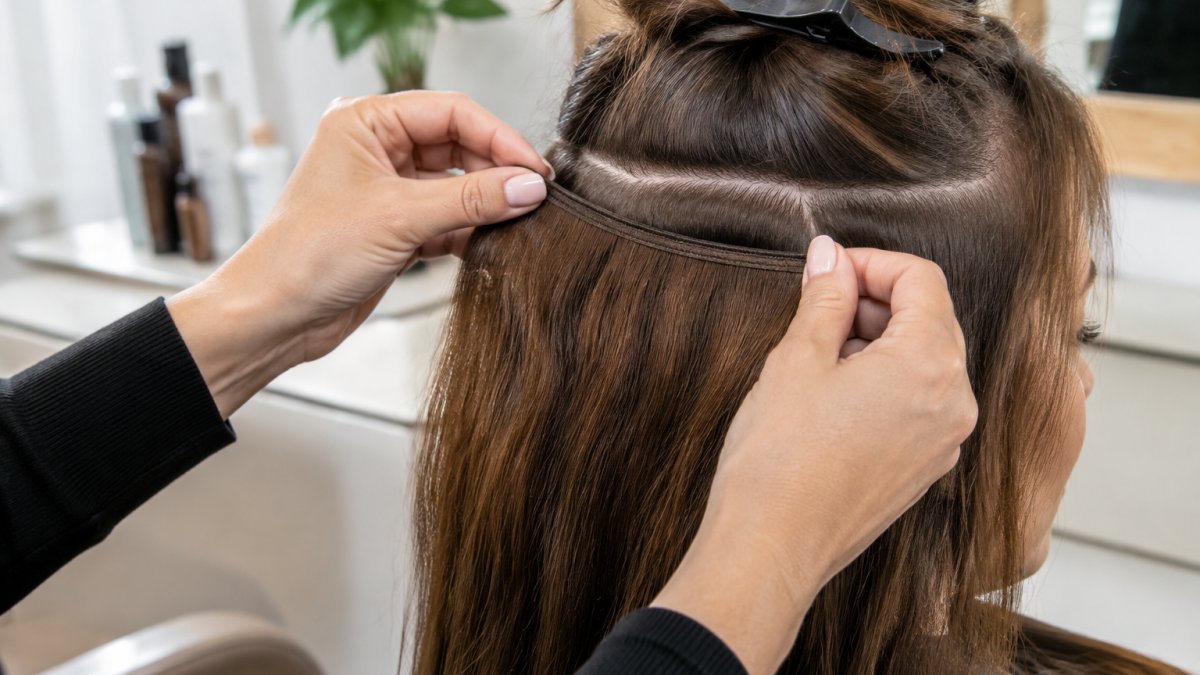
Three habits make the biggest difference:
- Match density to your own hair, not to the volume you want
- Ask for a soft root melt rather than a solid colour line
- Book a colour check before fitting, not after
Our step-by-step guide on how to blend extensions with natural hair covers sectioning, toning and the finishing cut in detail.
The Hair Extensions Care Routine That Protects Lifespan
A protective routine is the single biggest lever on how long extensions last.
Wash less often, use a colour-safe shampoo, and always dry the bond area fully. Research on hair dye use and adverse reactions shows that how people treat colour-treated hair varies widely, which is why a written routine beats guesswork.
For a full schedule you can follow at home, see our hair care routine for raw hair extensions.
What Changes Results: Factors That Shorten or Extend Wear
Several factors quietly shorten wear time, and most are controllable. Wash frequency, heat styling, sun exposure and porosity all affect how long a blend stays presentable.
Grey blending is a good example of expectations versus reality. A stylist's account of a six to nine month grey blending transformation describes the process as gradual, not a quick fix. The same patience applies to extension wear.
For a method-specific breakdown, our flat weft extensions lifespan guide explains what changes wear time in detail.
To get a realistic picture of how long a grey blend will last for you, it helps to understand the mechanisms behind each factor. Grey percentage is the first. If you have only a few silver strands, a blending technique can integrate them with minimal product and still look natural for months. If your grey is more than fifty per cent, you will need more colour work to keep the blend seamless, and the root line will become visible sooner. Starting colour matters too: dark hair transitioning to grey shows regrowth more starkly than light or pre-lightened hair, so a blend that works well on a blonde may need adjusting for a brunette.
Hair porosity affects how quickly colour fades. High-porosity hair, often from heat or chemical processing, loses pigment faster because the cuticle is raised and uneven. Low-porosity hair holds colour longer but can be resistant to absorbing it in the first place. Wash frequency is another lever: daily washing with a strong shampoo will strip colour and disrupt the blend far sooner than washing two or three times a week with a sulphate-free formula. Heat styling, sun exposure and water quality all contribute. Hard water deposits minerals that can dull colour and make hair feel rougher, while UV light breaks down pigment molecules over time.
A practical maintenance plan between appointments makes these factors manageable. For most clients, a simple schedule works well: use a colour-safe or sulphate-free shampoo and conditioner at home, wash no more than every other day, and apply a toning product every two to three weeks if you notice brassiness or fading. A leave-in UV protectant helps if you spend time outdoors. Return to your stylist when the root line becomes noticeable to you, not on a fixed calendar. For some, that is six weeks; for others, ten or twelve. If you are using extensions as part of the blend, check the bonds or tape every four to six weeks and book a professional tightening or reapplication as needed.
Rather than quoting a single figure, we recommend asking your stylist for an annual plan based on your grey percentage and starting colour. That gives you a realistic budget and time commitment, rather than a vague promise of low maintenance.
Choosing Your Bond Method and Shopping the Range
Choosing well comes down to your hair type, your appointment tolerance and your budget over a year. Fine to medium hair suits Nanobond; Invisi Tape suits fine hair; Keratin Bond suits thicker hair; Flat Weft sits close to the scalp with low bulk.
Every set uses 100% single-donor virgin hair with aligned cuticles and no silicone coating.
When you are ready, browse the full range on our hair extensions products page.
The real test of a blend is how it looks in month eight, not week one. If you want a set built to outlast the industry average, QUEEN OF GOOD HAIR offers single-donor virgin hair with full traceability, cuticle-intact strands that resist tangling, and a 12-24+ month lifespan. Get started with QUEEN OF GOOD HAIR and build a blend that still looks natural long after the average set has been replaced.
Frequently Asked Questions
How long do high-quality hair extensions usually last?
QUEEN OF GOOD HAIR states a 12 to 24+ month lifespan for its single-donor virgin hair, which has intact cuticles.
What makes hair extensions last longer than the industry average?
Three things matter most. First, cuticle alignment: single-donor hair keeps every strand running the same way, which prevents the friction that causes matting. Second, no silicone coating.
How can you make hair extensions blend naturally with your own hair?
Ask your stylist for a colour match on dry, finished hair rather than wet swatches, and choose a method suited to your density. Nano bonds and flat wefts sit closest to the scalp and disappear under fine hair. For blending hair extensions with natural hair, a gentle layer cut through the ends removes any blunt line, and lowlights through the top section soften the transition. Fine hair types usually need fewer, lighter strands rather than volume-packed sections.
Are single-donor hair extensions less likely to tangle?
Yes, in practice. When hair comes from one donor, the cuticles all face the same direction, so strands glide past each other instead of catching. Mixed-donor hair often has conflicting cuticle directions, which is why it mats within weeks even with careful washing. QUEEN OF GOOD HAIR supplies 100% single-donor virgin hair with intact cuticles and no silicone coating.
Can hair extensions be reused after removal?
Some can. INVISI TAPE extensions are reusable for up to 8 to 12 applications, making them the most economical choice over a year if you reapply regularly.
