

Nanobond vs Keratin Bond Extensions: Which to Choose?
Last Updated: 23 October 2026
Quick Summary
In the nanobond vs keratin debate, nanobond uses a tiny metal ring with no glue or heat and suits fine to medium hair, while keratin bond fuses strands with a heated polymer tip for the most secure hold, with refits typically due every 4 to 5 months. Neither is universally better; your hair density, root sensitivity and refit tolerance decide.
- Nanobond bonds are the smallest on the market, making them ideal for fine hair.
- Keratin bonds are typically refitted every 4 to 5 months.
- Nanobond hair is cuticle-intact single-donor virgin hair with a 12 to 24 month lifespan.
- Keep conditioner off nanobond rings, as slippage loosens them.
- Both ranges use the same single-donor hair, so the method is the variable.
Table of Contents
- Nanobond vs Keratin Bond Extensions: The Core Differences
- Side-by-Side Comparison: Nanobond and Keratin Bond
- How Long Do Nanobond Extensions Last?
- Best Hair Extensions for Fine Hair
- Nanobond Extensions Maintenance Tips
- Keratin Bond Care and Refit Realities
- How to Choose Between the Two Methods
- Frequently Asked Questions
Nanobond vs Keratin Bond Extensions: The Core Differences
Choosing between nanobond and keratin bond extensions comes down to one question: do you want the smallest possible bond at the root, or the longest-lasting attachment method? Nanobond extensions use a tiny metal ring with no glue and no heat. Keratin bond extensions fuse individual strands with a gentle heated polymer tip.

At QUEEN OF GOOD HAIR, we supply both methods in 100% single-donor virgin hair, so we can talk you through the trade-offs honestly. Neither is universally better. The right pick depends on your hair type, your routine, and how often you want to sit in a salon chair.
Here is the short version before we go deeper:
- Nanobond: discreet, gentle on the root, ideal for fine hair
- Keratin bond: the most secure hold, with refits typically due every 4 to 5 months, according to Queen of Good Hair's 2026 longevity guide
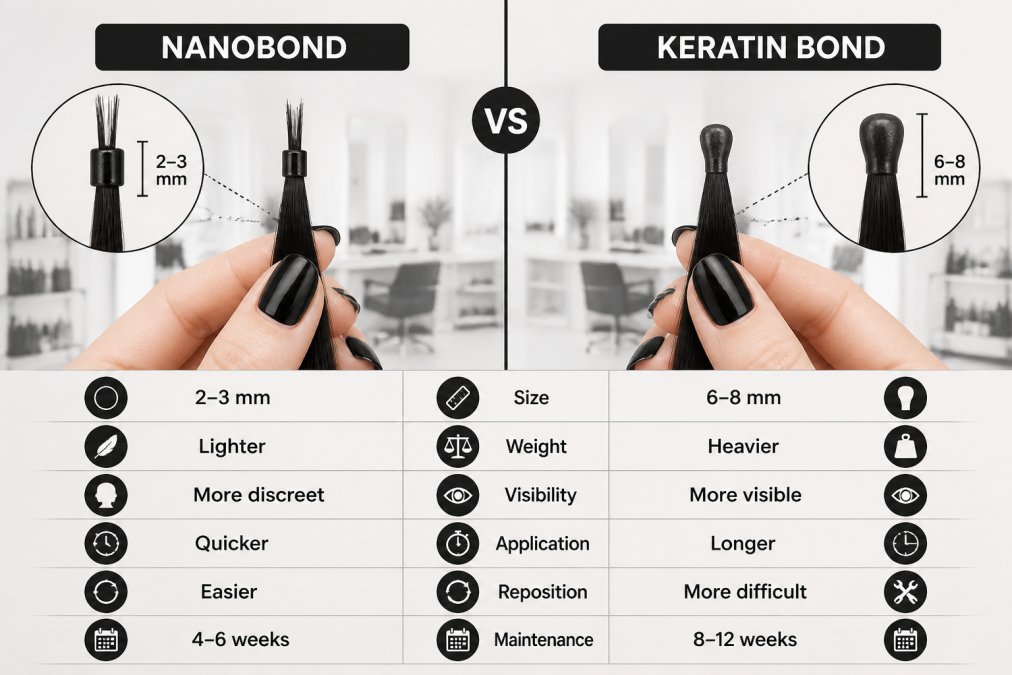
Side-by-Side Comparison: Nanobond and Keratin Bond
The table below sets out how the two methods differ on the points that actually affect your decision.
| Factor | Nanobond | Keratin Bond |
|---|---|---|
| Attachment | Metal ring, no glue or heat | Polymer tip fused with a heat wand |
| Bond size | Smallest on the market | Slightly larger, still discreet |
| Best hair type | Fine to medium | Medium to thick |
| Refit interval | Depends on regrowth and care | Typically 4 to 5 months |
| Removal | Ring opened, no solvent | Gentle heat and solvent |
| Risk to natural hair | Low, no adhesive | Higher if poorly applied |
The bond size difference matters most. A nanobond sits almost invisibly at the root, which is why it suits finer hair. Keratin gives a firmer, more permanent feel that many clients with thicker hair prefer.
How Long Do Nanobond Extensions Last?
Nanobond extensions typically last between refits in line with your natural hair growth, not a fixed calendar period.
The hair itself is a separate question. Our nanobond hair is cuticle-intact single-donor virgin hair with a 12 to 24 month lifespan, so the strands outlast several refits. What shortens life is poor aftercare, not the bond.
Best Hair Extensions for Fine Hair
For fine hair, nanobond is usually the better choice because the bond is smaller and lighter at the root. Fine hair has less volume to hide attachment points, so a bulky bond shows through quickly.
Our NANOBOND - 50g is built for fine to medium hair for exactly this reason.

Nanobond Extensions Maintenance Tips
Nanobond extensions maintenance tips come down to protecting the ring and the root. The ring does the holding, so anything that loosens it shortens the wear.
Follow these habits:
- Brush gently from mid-length down, never tugging at the root
- Keep conditioner off the bonds, as slippage loosens rings
- Dry the root area fully after washing to avoid moisture sitting under the ring
- Book a refit when rings start to sit away from the scalp
- Avoid heavy oil-based products near the attachment
Keratin Bond Care and Refit Realities
Keratin bond care is less forgiving than nanobond because heat and solvent are involved at removal. The bond is fused to a section of hair, so a rushed removal can pull or break strands.
Keratin bonds are reported to last 4 to 5 months between refits, per Queen of Good Hair's 2026 guide. Our KERATIN BOND - 50g is designed for 4 to 5 months between appointments.
How to Choose Between the Two Methods
Choosing between nanobond and keratin bond extensions should follow your hair, not a trend. Work through this checklist with your stylist:
- Hair density: fine hair leans nanobond, thicker hair can carry keratin
- Root sensitivity: sensitive scalps often tolerate rings better than adhesive
- Refit tolerance: can you commit to regular appointments?
- Styling habits: heat styling near bonds favours nanobond
- Budget over time: factor in refits, not just the first fitting
Both our nanobond and keratin ranges use the same single-donor, cuticle-intact hair, so quality is not the variable. The method is.
Frequently Asked Questions
Are nanobond extensions better for fine hair than keratin bonds?
For fine hair, nanobond extensions are usually the better choice. The nano ring is the smallest, most discreet bond available and sits almost invisibly at the root, so it does not add bulk. Keratin bonds are slightly larger and can show through very fine hair if not applied carefully. That said, a skilled stylist can fit keratin bonds on fine hair using smaller sections. If your client has naturally thin hair and worries about a bulky look, start with nanobond and assess how the hair settles after the first week.
How long do keratin bond extensions last compared to nanobonds?
Keratin bond extensions are reported to last 4 to 5 months between refits, according to Queen of Good Hair's 2026 guide. Nanobond refits are typically scheduled every 6 to 8 weeks because the rings need tightening as the natural hair grows. The hair itself, when it is single-donor virgin hair with intact cuticles, can last 12 to 24 months across multiple installations. The refit schedule is what differs, not the lifespan of the hair.
Do nanobond extensions cause more damage than keratin bonds?
Neither method is automatically gentler. Nanobonds use no glue and no heat, which removes the risk of heat damage at the bond point, but the ring must not be fitted too tightly or it can pull on the root. Keratin bonds use a gentle heat wand. Correct sectioning, weight distribution and aftercare matter more than the method itself.
Can you reuse keratin bond extensions?
Keratin bonds are generally used for one installation only. The bond is fused to the strand with heat and removed by breaking it down, which means the same bond cannot be reliably reapplied. Nanobond rings, by contrast, can be removed and the hair re-tipped or re-ringed for a second installation. If your client wants to maximise the 12 to 24 month lifespan of single-donor virgin hair, nanobond gives more opportunity to reuse the hair itself across refits.
The real challenge is not picking a method, it is finding hair good enough to justify either one. At QUEEN OF GOOD HAIR, every bundle is 100% single-donor virgin hair with a full chain of traceability, ethically sourced and free from silicone coating. That means no tangling, no matting, and a 12 to 24 month lifespan. Get started with QUEEN OF GOOD HAIR and choose your method with hair you can trust.
