

How to Match Hair Extension Colour to Natural Hair
Last Updated: November 1, 2026
Quick Summary
To match hair extension colour to natural hair, always judge the shade in indirect daylight rather than under salon bulbs, checking the roots, mid-lengths and ends separately. Take your main reference from the mid-lengths and ends, then confirm with a real swatch ring before committing.
- Artificial salon lighting shifts how pigment reads, so a match can look wrong outdoors.
- Treat screen-based colour charts as a shortlist and confirm with physical swatches.
- Match the mid-lengths and ends for the main shade, using a darker root shadow.
- Read undertones in daylight: warm reflects gold or copper, cool reflects ash or violet.
- Match texture and curl pattern before colour, or the extensions still look obvious.
Table of Contents
- Why Natural Light Is the Only Light That Tells the Truth
- How to Use a Hair Extension Colour Chart Guide
- Matching Roots, Mid-Lengths and Ends: Where to Take Your Colour From
- Undertones, Highlights and Lowlights: Reading Your Base Colour
- Texture and Curl Pattern: Match the Movement Before the Colour
- Best Hair Extensions for Thin Hair: Matching Without Bulk
- How to Blend Hair Extensions with Short Hair
- Book a Colour Match with the QOGH Colour Ring
- Frequently Asked Questions
Why Natural Light Is the Only Light That Tells the Truth
Learning how to match hair extension colour to natural hair starts with one rule: judge the shade in daylight, never under salon bulbs.
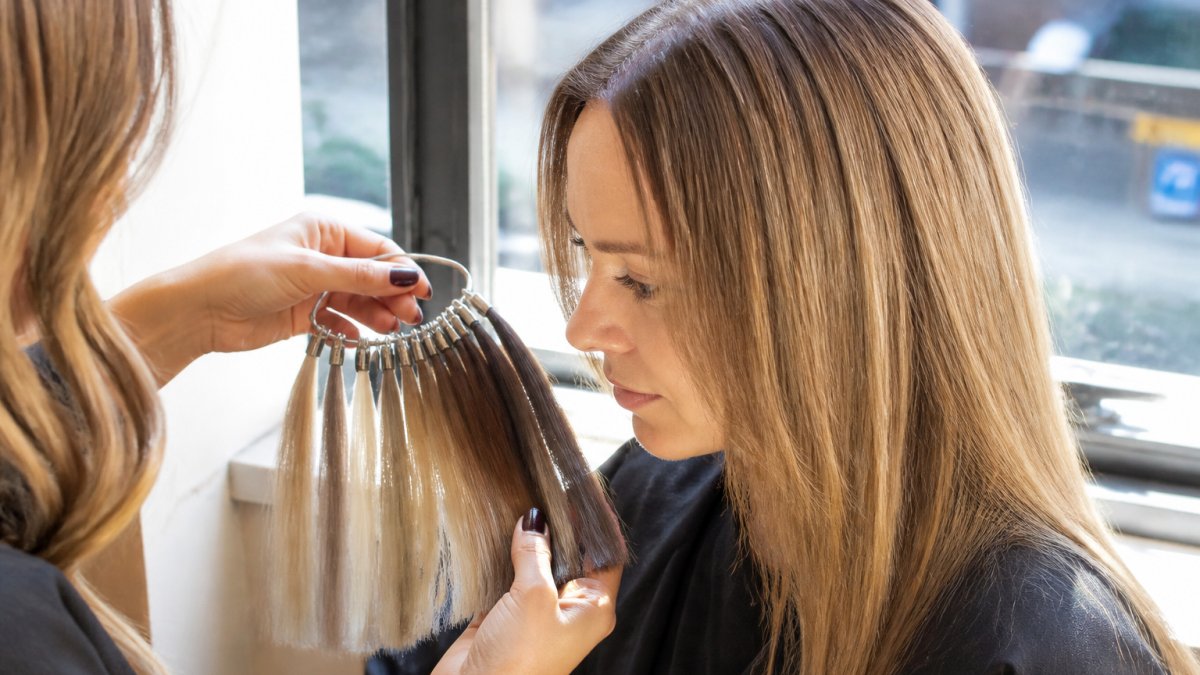
A warm-toned extension chosen under yellow salon lighting can read brassy in daylight. A cool shade picked under fluorescent strips can look flat and grey outdoors.
Here's the practical fix:
- Take the hair to a window with indirect daylight
- Hold swatches against the hair at eye level, not under a lamp
- Check the match at the root, mid-lengths and ends separately
Natural light is the only reference your client's hair will actually live in. The NHS guidance on indoor lighting and eye comfort is a reminder of how much lighting changes what we perceive, and colour is no different.
How to Use a Hair Extension Colour Chart Guide
A hair extension colour chart guide is a reference tool that maps every shade in a range against numbered swatches, so you can compare your client's base colour to a fixed standard instead of guessing. Used well, it can reduce guesswork in a colour match. Used badly, it creates a false sense of certainty, because a chart on a screen is not the same as a chart in your hand.
Why screen-based charts mislead
Every monitor renders colour differently. A shade that looks ash-brown on your phone can read warm chestnut on a laptop, and neither may match the actual swatch. Brightness settings, blue-light filters and even the angle of the screen all shift how pigment appears. If you are matching from a digital chart, treat it as a shortlist, not a decision.
The practical workflow is:
- Note the client's base colour in daylight first, roots, mid-lengths and ends separately
- Find the two or three closest chart shades on screen
- Order physical testers or a swatch ring to confirm
- Compare the real swatch against the hair in indirect daylight before committing
Digital colour matching tools: what they can and cannot do
A newer development is app-based colour matching, where you photograph the client's hair and the tool suggests the closest extension shades. These tools are useful for narrowing a wide range quickly, especially if you are ordering remotely or advising a client who is not in the chair. But they have limits you need to understand:
- Lighting bias: the app reads the photo, not the hair. If the photo was taken under warm indoor light, the suggested shade will lean warm.
- Camera processing: most phones apply automatic colour correction that subtly shifts tone.
- No texture read: a digital tool can suggest a colour but cannot tell you whether the extension will move like the client's natural hair.
Use digital tools as a first pass. Use a real swatch ring as the final check. The chart narrows the field; the physical swatch makes the call.
Our QOGH Colour Ring puts every shade in our range on one ring, in real hair, so you can match in person rather than from a screen.

Matching Roots, Mid-Lengths and Ends: Where to Take Your Colour From
Take your colour reference from the mid-lengths and ends, not the roots. Most natural hair is darker at the root and lighter through the lengths, so matching to the root alone makes extensions look heavy and obvious.
A common mistake is matching everything to the base. In practice, this means:
- Roots: use these to choose a root shadow or darker blend shade
- Mid-lengths: the main body of the extension should sit close to this tone
- Ends: match lighter ends with a slightly lighter shade for a natural gradient
If your client has a big gap between root and end colour, a single shade will never blend. You need two.
Match each section of the hair separately rather than picking one flat shade.
| Section | What to match | Why |
|---|---|---|
| Roots | A root shadow or darker blend shade | Natural hair is usually darker at the root |
| Mid-lengths | The main body of the extension | This is the dominant tone of the hair |
| Ends | A slightly lighter shade | Creates a natural gradient |
| Big root-to-end gap | Two shades, not one | A single shade will never blend |
Undertones, Highlights and Lowlights: Reading Your Base Colour
Undertones decide whether a shade reads warm, cool or neutral, and getting them wrong is the fastest way to a visible mismatch. Two clients can both describe their hair as "brown" and need completely different extension shades.
Read the undertone in daylight:
- Warm tones: gold, copper or red reflects
- Cool tones: ash, blue or violet reflects
- Neutral tones: a balance of both, with no strong cast
Highlights and lowlights add a second layer. If your client has visible highlights, a flat single-shade extension will look dull next to them.
Matching balayage and high-contrast colour
Balayage is where most colour-matching advice falls apart. A balayage client does not have one colour, they have a dark root, a transition zone, and a light end, often with tonal variation through each section.
The workable approach is to match in zones:
- Root zone: choose a shade close to the natural root, or a root shadow shade one level darker
- Transition zone: this is where most of the blending happens. Match the extension's mid-lengths to the midpoint of the balayage transition, not to the root and not to the end
- End zone: match the lightest section with a shade that echoes the end tone, then blend a second shade through if the balayage has visible dimension
For high-contrast balayage, where the root and end are several levels apart, a two-shade mix is usually the minimum. Some stylists use three: a root shade, a mid shade and an end shade, blended in the same proportion as the natural hair.
Matching silver, grey and transition colour
Grey and silver hair is another scenario where generic advice fails. Natural grey is rarely a flat cool tone, it often has warm or neutral undertones, especially in transition hair where some pigment remains. A cool ash extension matched against warm-leaning grey will look purple or flat.
The practical rules for grey and silver:
- Read the grey in daylight, not under salon lighting, which can make grey look cooler than it is
- Match the dominant undertone of the grey, not the idea of "grey" as a colour
- If the client is transitioning from coloured to natural grey, match the extension to the current overall tone rather than the eventual grey, unless they plan to transition the extensions too
How extensions change tone after washing
A colour match that looks perfect on day one can drift after several washes. Extensions and natural hair do not fade at the same rate, and the difference becomes visible over time.
What typically happens:
- Natural hair fades gradually and often warms up slightly with sun and washing
- Extensions can fade faster or slower depending on the hair's processing and the products used
- Warm shades tend to warm up further; cool shades can lose tone and read flatter
The fix is not to over-match on day one. If anything, match slightly toward the tone the hair will settle into after a few washes, and advise the client on sulphate-free aftercare to slow the drift.
The colour perception guidance from the Royal National Institute of Blind People underlines how individual colour vision varies, which is exactly why a second pair of eyes on the match helps, especially with complex colour where the gradient matters as much as the base tone.
Texture and Curl Pattern: Match the Movement Before the Colour
Match the texture and curl pattern first, then the colour. A perfect colour match on the wrong texture still looks like extensions, because the two hair types move and fall differently.
This is the part most guides skip. In practice, texture matching means:
- Match the natural wave or curl pattern as closely as you can
- Check how the extension falls next to the natural hair, not just how it looks flat
- Allow for how the hair behaves after washing and styling
Once the texture is right, the colour sits on top of a foundation that already blends. How to install hair extensions like a pro shows how to keep that match seamless after fitting.
Best Hair Extensions for Thin Hair: Matching Without Bulk
The best hair extensions for thin hair are lighter, flatter options that add colour and length without adding weight or a visible ridge. Bulk is the enemy here, not colour.
Fine hair shows everything: a thick weft, a heavy root, a shade that's half a tone off. So the matching rules tighten:
- Choose a shade that sits within one tone of the natural base
- Favour lighter-weight options over dense, heavy wefts
- Keep the root match soft so the join disappears, and follow a step-by-step guide to hiding weft tracks once the extensions are fitted
How to Blend Hair Extensions with Short Hair
Blending extensions with short hair comes down to cutting and placement, not colour alone. Short natural hair gives the extensions less to hide behind, so every choice shows.
What works:
- Match the colour to the ends, where the blend happens
- Ask for a cutting technique that removes visible separation
- Keep the extension length close to the natural length at first
Colour gets you close. The cut makes it invisible. For the practical techniques, see how to blend extensions with hair naturally.
Book a Colour Match with the QOGH Colour Ring
The most reliable way to match hair extension colour to natural hair is to compare real swatches against the hair in daylight, in person. No screen, no guesswork.
Our QOGH Colour Ring holds every shade in our range on one ring, in real hair, fanned for quick comparison.
- Real hair swatches in every shade
- Fanned on a single metal ring
- Matched against natural hair in daylight
Order the ring, match in person, and choose with confidence.
Frequently Asked Questions
Should I match my hair extensions to my roots or my ends?
Match to your mid-lengths and ends, not your roots. Roots are usually darker, and if you match there the extensions will look heavy and obvious against the rest of your hair. Take a strand from around ear level and hold the swatch against it in daylight. If your hair is highlighted or balayage, match the dominant mid-tone and consider mixing two shades so the extension carries the same depth as your natural colour.
Can I mix two different hair extension colours for a better match?
Yes, and for most people it gives a more convincing result than a single flat shade. Mixing two close shades, for example a warm base with a slightly lighter tone, mimics the way natural hair reflects light. Stylists often blend in equal portions to create a custom colour profile. Order both shades, test them together in daylight, and keep the ratio consistent across bundles so repeat orders stay identical.
How does lighting affect hair colour matching?
Indoor bulbs and phone screens both distort colour. Warm salon lighting pushes hair towards gold, while cool white bulbs make it look ashier than it is. Always check a swatch against your hair in indirect daylight, near a window rather than in direct sun. If you match under artificial light only, you risk ordering a shade that looks wrong the moment you step outside. Daylight is the reference every other light is judged against.
Can hair extensions be toned or dyed to match my colour?
A professional consultation is the safest route. Test on a small hidden section first, and remember that any colour work changes how the hair behaves, so allow for that in your aftercare routine.
Matching colour well takes the right tools and a trained eye. If you want a match you can trust before you order, start with the QOGH Colour Ring and compare real hair against real hair in daylight. Shop All at QUEEN OF GOOD HAIR and give every client a seamless, natural result.
