

Why Do Hair Extensions Tangle Quickly? Causes & Fixes
Table of Contents
- Why Do Hair Extensions Tangle Quickly? The Main Causes
- Why Do Hair Extensions Thin Out and Tangle Together?
- How to Detangle Hair Extensions Without Damaging Them
- The Best Brush for Hair Extensions (and What to Avoid)
- How to Sleep with Hair Extensions to Prevent Tangling
- Choosing Extensions That Resist Tangling: What to Look For
- Frequently Asked Questions
Last Updated: September 21, 2026
Why Do Hair Extensions Tangle Quickly? The Main Causes
If your hair extensions tangle within days of fitting, the cause is almost always the hair itself, not your aftercare. Hair extensions tangle quickly when the cuticles on each strand face different directions, when silicone coatings wear off and expose hidden damage, or when the hair dries out and roughens.
Here's the core tension in this category. Most extensions sold as "virgin" or "remy" are blended from multiple donors. That sounds harmless. It isn't. Every donor's hair has a slightly different texture, and when strands from different heads are mixed, the cuticles clash. Rough cuticles catch on each other. The result is matting at the roots, tangling through the mid-lengths, and a set that feels tired within weeks.
So why does this happen so fast? Three reasons, and only one of them is fixable at home.
Cuticle Alignment: The Single Biggest Factor
Cuticle alignment is the single biggest factor in whether extensions tangle. The cuticle is the outer layer of each hair strand, made of overlapping scales. When every strand runs in the same direction, those scales lie flat and hair glides against itself. When they don't, the scales lift and grip.
Single-donor hair keeps the cuticle aligned because it all comes from one head. Blended hair cannot, no matter how carefully it's processed. This is why a cheap bundle tangles in a fortnight while a properly sourced one stays smooth for months.
Silicone Coatings That Hide Damage
Silicone coating is the industry's favourite shortcut, and it's why so many extensions feel wonderful for two weeks and terrible after. Manufacturers coat damaged or misaligned hair in silicone to make it feel soft and shiny on arrival. You can't see the damage because it's sealed under a layer of product.
Then you wash it. The coating strips away, and the rough, worn hair underneath is exposed. Tangling starts almost immediately, and it gets worse with every wash. This is the most common reason people tell us their last set "died" within a month.
The fix is simple to describe and hard to fake: buy hair that never needed coating in the first place. Cuticle-intact, single-donor hair has nothing to hide.
Why Do Hair Extensions Thin Out and Tangle Together?
Hair extensions thin out and tangle together because shedding and dryness work as a pair. Each strand that sheds stays trapped in the surrounding hair instead of falling away. Those loose strands wrap around the healthy ones, and the whole section mats into a knot. Thinning and tangling are the same problem seen from two angles.
Here's what drives it:
- Shedding from weak bonds. Poor-quality bonds loosen early, releasing strands into the body of the hair.
- Dryness. Extensions get no natural oils from your scalp, so they dry out faster than your own hair.
- Heat damage. Straighteners and curling wands above 180°C rough up the cuticle over time.
- Product build-up. Heavy conditioners and oils collect near the bonds and glue strands together.
- Friction. Collars, scarves, and car headrests rub the mid-lengths and cause knots.
If your extensions are thinning across the whole set rather than at the bonds, look at dryness and heat first. If they're thinning in patches, the bonds are the likely culprit.
How to Detangle Hair Extensions Without Damaging Them
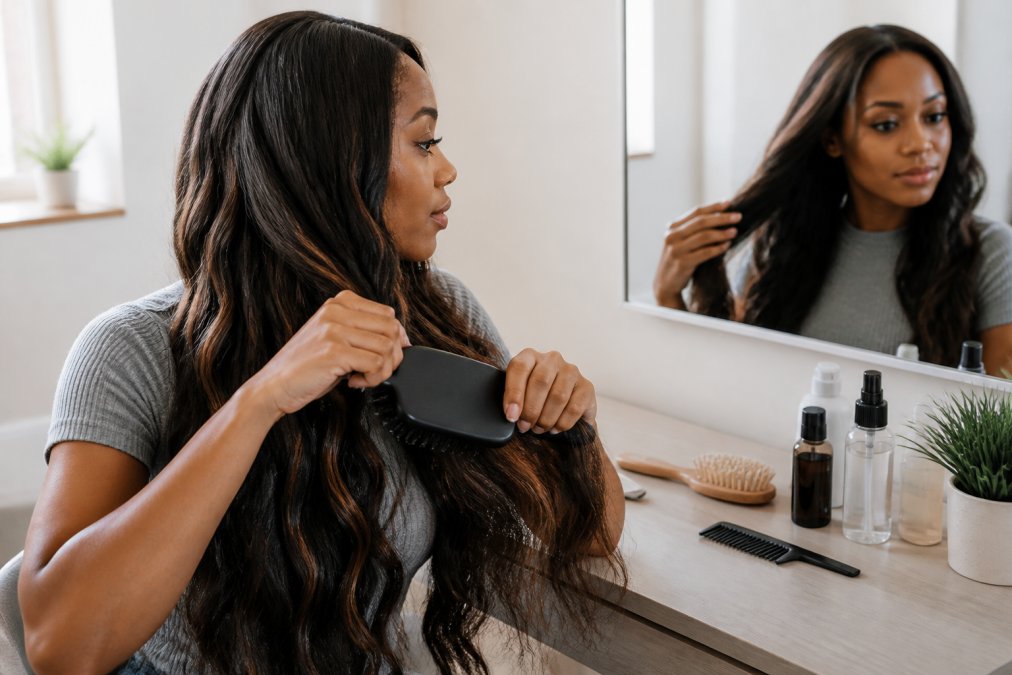
The safe way to detangle hair extensions is to work from the ends upward, in small sections, using a wide-tooth comb on dry or lightly conditioned hair. Never start at the roots. Never pull through a knot. And never detangle wet hair with a fine brush, because wet hair stretches and snaps.
Step-by-Step Detangling Method
Follow this order every time, and you'll lose far fewer strands:
- Separate the hair into four sections with clips.
- Hold the section near the mid-lengths so you're not pulling on the bonds.
- Start at the ends and comb downward in short strokes.
- Move up gradually, an inch at a time, until you reach the bonds.
- Spray a light leave-in conditioner on stubborn knots and wait 30 seconds.
- Ease the knot apart with your fingers before combing through it.
- Never tug. If it won't move, add more conditioner and start again.
Expected result: smooth hair with minimal shedding and no damage to the bonds.
The Best Brush for Hair Extensions (and What to Avoid)
The best brush for hair extensions is a soft-bristle paddle brush or a wide-tooth comb with smooth, seamless teeth. Loop brushes and boar-bristle brushes work well on your natural hair but catch on bonds and wefts. Anything with a rough seam along the teeth will shred the cuticle.
What to avoid:
- Fine-tooth combs, which snag at the bond points
- Round brushes, which trap hair and pull at the roots
- Metal brushes, which generate friction and static
- Any brush with exposed seams or rough edges
A common mistake is buying an expensive brush and using it on soaking wet hair. Wet extensions are at their most fragile. Comb them dry, or use a wide-tooth comb with plenty of conditioner while washing.
How to Sleep with Hair Extensions to Prevent Tangling
Sleeping with hair extensions safely means tying them back loosely and protecting them from friction overnight. Most tangling happens while you sleep, because eight hours of rubbing against a cotton pillowcase roughs up the cuticle and wraps loose strands together.
Do this every night:
- Brush thoroughly before bed, following the method above
- Plait loosely or tie in a low ponytail with a soft, snag-free band
- Never sleep with wet extensions, as wet hair stretches and mats
- Use a silk or satin pillowcase to cut friction
- Avoid tight buns, which strain the bonds at the root
Loose is the key word. A tight plait pulls on the bonds all night and causes more shedding than leaving hair free.
Choosing Extensions That Resist Tangling: What to Look For
The extensions that resist tangling share three traits: single-donor sourcing, intact cuticles, and no silicone coating. Everything else is marketing.
Use this checklist before you buy:
- Single donor confirmed. Ask directly. If the answer is vague, walk away.
- Cuticle-intact stated. Not "cuticle-corrected" or "cuticle-friendly."
- No silicone coating. Ask if the hair is coated for shine.
- Traceable origin. A brand that can tell you where the hair came from can usually tell you how it was handled.
- Realistic lifespan. Properly made extensions can last 12 months or more with good care.
The UK Government guidance on fair trading and product descriptions makes clear that goods must match their description. "Virgin hair" and "single donor" are descriptions, not slogans. Hold sellers to them.
This is where the QUEEN OF GOOD HAIR approach differs from most of what's on the market. Every bundle is 100% single-donor virgin hair with cuticles aligned in one direction, and we publish the full chain of traceability from donor to delivery. No silicone coating, because there's no damage to hide. That's why our extensions carry a 12 to 24 month lifespan, and why our customers report no tangling or matting with proper care.
For fine or thin natural hair, the NANOBOND - 50g at £127 uses the smallest bond on the market and stays invisible at the root.

| Method | Fitting Time | Best For | Bond Visibility |
|---|---|---|---|
| Nanobond | Longer appointment | Fine to medium hair | Invisible at root |
| Invisi Tape | Under an hour | Fast fitting, high ponytails | Undetectable |
| Keratin Bond | Longer appointment | Longest wear between visits | Seamless, natural |
| Flat Weft | Moderate | No bulk or bumps | Sits close to scalp |
Frequently Asked Questions
Why do my hair extensions get matted at the nape of my neck?
The nape area traps natural oils, sweat and friction from clothing collars, which causes hair extensions to tangle and mat there first. This is especially common with weft or tape methods that sit close to the scalp. Brushing the nape section gently each morning and before bed helps break up early tangles. Using a silk pillowcase and tying hair in a loose plait at night also reduces friction against the neck.
Does sleeping with wet hair extensions cause tangling?
Yes. Wet hair is more elastic and fragile, so friction against a cotton pillowcase causes the cuticles to catch and knot. Always dry your hair extensions fully before bed, or at minimum apply a leave-in conditioner and loosely plait them. If you must sleep with damp hair, use a silk or satin pillowcase and keep the hair secured in a loose plait to minimise movement and rubbing.
Do cheaper hair extensions tangle more easily than virgin hair?
Often, yes. Lower-priced extensions frequently use hair with mixed cuticle directions or a silicone coating that temporarily masks damage. Once that coating washes off, the cuticles catch on each other and tangle fast. Single-donor, cuticle-intact virgin hair keeps all strands aligned in the same direction, which dramatically reduces tangling. Products like the KERATIN BOND (from £127) use this approach for longer-lasting results.
How often should I brush my hair extensions to prevent tangling?
Brush at least twice daily: once in the morning and once before bed. Use a soft bristle brush designed for extensions, and work from the ends upward in small sections. Never brush wet extensions with a standard brush. If you wear tape or nano extensions, pay extra attention to the bonds, as tangles often start just below the attachment point. Regular brushing stops small knots from becoming matted sections.