

Benefits of Single Donor Hair Extensions: 2026 Guide
Table of Contents
- What Single Donor Hair Actually Means
- Raw Virgin Hair Extensions and Why Processing Changes Everything
- The Core Benefits of Single Donor Hair Extensions
- How to Identify High Quality Hair Extensions
- Hair Extension Longevity Tips for Daily Wear
- Ethical Sourcing and Traceability: What to Ask Before You Buy
- Conclusion
- Frequently Asked Questions
Last Updated: 15 September 2026
What Single Donor Hair Actually Means
Single donor hair is hair sourced from one individual donor, with every strand kept together from cutting through to wefting. This is the definition that matters, because it is the difference between extensions that behave like your own hair and extensions that fight it.
Most budget wefts are blended from multiple donors. The cuticles run in opposing directions, so strands grip each other, knot, and matt. At QUEEN OF GOOD HAIR, we work exclusively with single-donor hair precisely because the alternative creates problems no aftercare routine can fix.
Below, we break down what the benefits of single donor hair extensions actually are, how to spot genuine quality before you buy, and how to make a set last.
Single donor versus multi-donor: the cuticle question
A cuticle is the outer layer of each hair strand, and it has a direction, like a roof tile. When all the cuticles in a bundle face the same way, the hair glides. When they don't, it snags against itself.
Multi-donor hair cannot guarantee alignment, because the strands come from different heads with different growth patterns. Single donor hair can, and that alignment is the single biggest factor in how the hair performs over months of wear.
Raw Virgin Hair Extensions and Why Processing Changes Everything
Raw virgin hair extensions are made from unprocessed hair that has never been chemically treated, acid-washed, or coated. The hair retains its natural cuticle, which is what allows it to move, dry, and style like hair still growing from a scalp.
Processing is where quality quietly disappears. Common treatments include:
- Acid baths that strip the cuticle to speed up production, leaving hair thinner and prone to breakage
- Silicone coating that creates a temporary shine, which washes out after a few weeks and reveals dry, dull hair underneath
- Chemical straightening that removes the natural wave pattern and weakens the strand structure
The problem with coated hair is timing. It looks excellent in the packet and disappointing by week six. Unprocessed hair looks slightly less glossy on day one and dramatically better on day 200.
The Core Benefits of Single Donor Hair Extensions
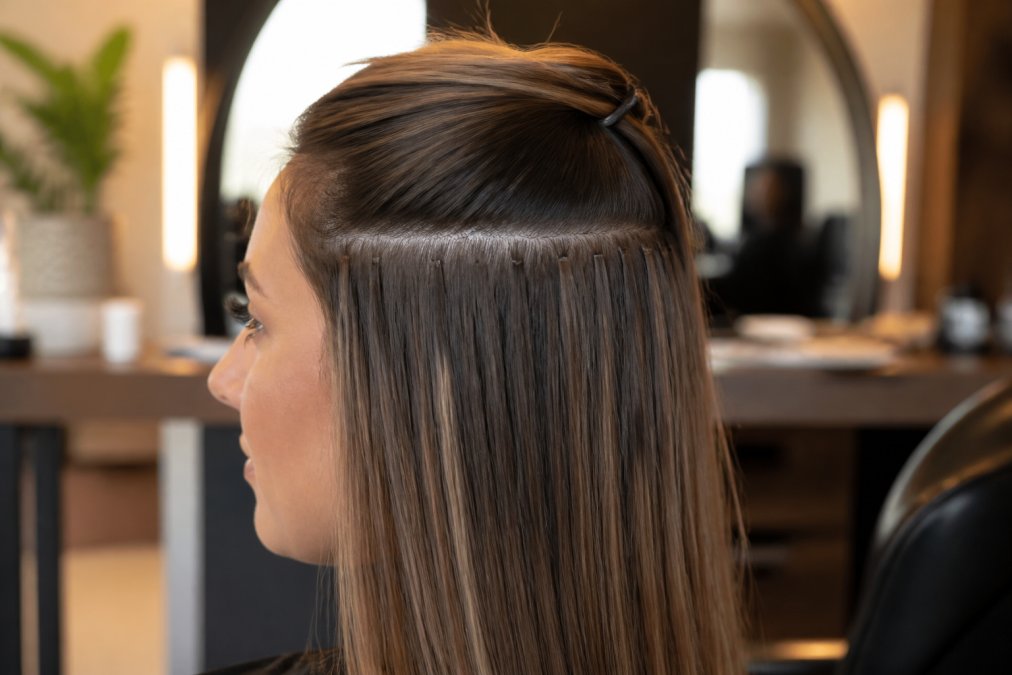
The benefits of single donor hair extensions come down to three things: less tangling, better blending, and a longer useful life. Aligned cuticles mean the hair doesn't catch on itself, which is the root cause of most matting complaints.
Less tangling and matting
Matting happens when cuticles in opposing directions lock together. A common mistake is blaming brushing technique or product choice for matting that is actually baked into the hair at the point of manufacture. No leave-in conditioner reverses misaligned cuticles.
With single donor hair, the cuticles run one way. Brushing moves through the hair rather than dragging against it.
Better blending on fine hair
Fine hair is where multi-donor wefts expose themselves. Bulkier, coarser strands sit visibly on top of finer natural hair, and the contrast reads as "extensions" from across a room.
Single donor hair can be matched on strand thickness as well as colour, so the extension hair falls at the same weight and texture as the client's own. For anyone with naturally thin or fine hair, this is not a luxury. It is the difference between a result that looks intentional and one that looks added on.
How to Identify High Quality Hair Extensions
Knowing how to identify high quality hair extensions takes about two minutes if you know what to look for. Skip the packaging claims and test the hair itself.
- Check the direction test. Wet a small section and run fingers both ways. Smooth one direction, resistant the other, means the cuticle is intact.
- Look for a silicone smell or slick feel. Coated hair feels unnaturally slippery and may smell faintly chemical.
- Separate a weft. Shedding several strands from a single tug suggests weak wefting.
- Ask about donor count. A supplier who cannot answer this clearly is not tracking it.
- Request traceability details. Origin, collection method, and processing history should be documented, not described in general terms.
- Test a colour lift on a spare strand. Virgin hair takes colour predictably. Processed hair reacts unevenly.
If a supplier avoids the donor question, treat that as your answer.
Hair Extension Longevity Tips for Daily Wear
These hair extension longevity tips apply to any quality hair, but single donor hair rewards good habits far more than coated hair does, because there is no silicone layer to hide damage.
- Brush before washing, not after. Detangle dry hair from ends upward, working in sections.
- Wash less often than you think. Two or three times a week suits most wearers.
- Use sulphate-free products. Harsh surfactants strip moisture that virgin hair holds naturally.
- Keep heat below 180°C. Always use a heat protectant, and never apply irons directly to the bond area.
- Dry the bonds thoroughly. Trapped moisture at the attachment point is a leading cause of slippage.
- Book maintenance checks. A professional can spot early shedding before it becomes a full re-fit.
Ethical Sourcing and Traceability: What to Ask Before You Buy
"Ethically sourced" is used loosely across the industry. The only version that means anything is one you can verify, which is why traceability matters more than the phrase itself.
A supplier with genuine traceability can tell you where the hair came from, how the donor was compensated, and how the hair was handled before it reached the weft. That chain is what separates a documented product from a marketing claim.
Ask directly:
- Which country and region did this hair come from?
- How are donors compensated, and is that payment documented?
- What processing, if any, has the hair undergone?
- Can you provide batch consistency records across orders?
For salon owners, that last question matters commercially. Clients notice when a re-order feels different from the last one, and inconsistent batches cost you the client, not the supplier.
QUEEN OF GOOD HAIR documents the full chain from donor to delivery, and our founder Tammy Laroche brings 30 years of industry experience to sourcing decisions. Verified buyers including Jodie, Libby Bryson, and Robina have reviewed us at 5.0 from 7 reviews, and our team holds Habia CPD certified training.
Conclusion
The gap between hair that lasts months and hair that matts within weeks is not luck. It is donor count, cuticle alignment, and whether anyone can prove where the hair came from. Ask the hard questions before you buy, and test the hair yourself rather than trusting the label.
If you want a set that holds its condition through daily wear, colouring, and repeat washing, QUEEN OF GOOD HAIR supplies 100% single-donor virgin hair with full traceability from donor to delivery, no silicone coating, and a 12 to 24+ month lifespan. Our team can match strand thickness and colour to fine or thinning hair for a genuinely seamless result.
Shop All and start with hair that behaves like your own.
Frequently Asked Questions
What does single donor hair mean?
Single donor hair comes from one person's head, so every strand in a bundle shares the same colour, texture and cuticle direction. That consistency is what stops the hair from fighting itself. When cuticles are aligned and unbroken, the strands lie flat together instead of catching on each other, which is the main reason single donor hair tangles far less than mixed bundles.
Why is single donor hair better than multi-donor hair?
Multi-donor bundles blend hair from several people, and the cuticles rarely run the same way. When opposing cuticles meet, they grip and mat, especially after washing. Single donor hair keeps cuticles aligned, so it stays smooth and behaves like your own hair. That alignment is also why single donor hair typically holds its condition for 12 to 24 months with proper care, rather than a few months.
How can you tell if hair extensions are from a single donor?
Ask for the traceability chain: where the hair came from, how it was cut, and whether it was ever acid-bathed or silicone-coated. Then test a strand. Run your fingers down it; it should feel smooth in one direction and slightly rougher in the other, which shows the cuticle is intact. Dip a few strands in water. Untreated raw virgin hair extensions will absorb it and return to a natural wave, while coated hair stays slick and unnaturally straight.
How long do single donor hair extensions typically last?
With daily wear and regular washing, expect 12 to 24 months before the hair itself needs replacing. That range depends on how you care for it: sulphate-free products, heat protection, and gentle brushing from the ends up will keep it at the top of that window. Extensions that mat within weeks usually point to mixed cuticles or silicone coating rather than genuine single donor hair.
Do single donor hair extensions tangle less?
Yes, and the reason is mechanical rather than cosmetic. Aligned cuticles let strands slide past each other instead of locking together. Silicone coating can mimic that smoothness for a few washes, but once it wears off the roughened cuticle underneath starts to grip. Uncoated single donor hair has nothing to strip away, so the low-tangle behaviour lasts as long as the hair does.
Is single donor hair the same as virgin hair?
Not quite. Virgin hair simply means the hair has not been chemically processed, coloured or permed. Single donor describes the source: it all came from one person. You can have virgin hair from several donors mixed together. The strongest option is both at once, which is why raw virgin hair extensions from a single donor combine unprocessed quality with cuticle alignment.