

7 Short to Long Hair Extension Transformations That Work
Last Updated: November 5, 2026
Quick Summary
Short to long hair extensions work best when the method matches the starting cut: a bob can hide a bond row at the nape, while a pixie is realistically taken to shoulder length in stages rather than waist length in one sitting. Blending decides the result, so always trim the extensions to meet your natural hair, never the other way round.
- A bob is the easiest starting point because there is enough length at the back to hide the bond row.
- A pixie cut is realistically taken to shoulder length in stages, not waist length in one sitting.
- Section the natural hair into lower, middle and top sections before fitting any extension row.
- Point-cut the extension ends to soften the line where they meet the natural hair.
- Tape and weft methods sit flat and hide under a bob more easily than clip-ins or halos.
Table of Contents
- What Short to Long Hair Extensions Really Change
- Before and After: Seven Transformations Worth Seeing
- How to Blend Hair Extensions with Short Hair
- The Best Hair Extensions for Short Hair
- Hair Extension Length Guide: Choosing Your Ideal Finish
- Hair Extensions for Fine Hair: Adding Volume Without Bulk
- Care, Wear Time and Safe Removal After a Transformation
- Book Your Short to Long Consultation
- Frequently Asked Questions
What Short to Long Hair Extensions Really Change
Short to long hair extensions change more than length. They change how a client sees themselves in the mirror.
Most people assume the transformation is about adding centimetres. It isn't. A good set adds weight, movement and shape. It fills the gaps a short cut leaves behind.
Short to long hair extensions are a length transformation built on matching the right method to the haircut already on the head.
Here is the honest part. Extensions carry a reputation for damage, and that reputation is not invented.
Below, we break down seven transformations worth seeing, how to blend them, and how to choose a method for short hair.
Before and After: Seven Transformations Worth Seeing
Before and after photos are the fastest way to judge what a length transformation can achieve. The seven cases below cover the most common starting points we see: bobs, pixies, fine hair and thinning hair on top.
Each one follows the same logic. The shorter the starting cut, the more the blending work matters.
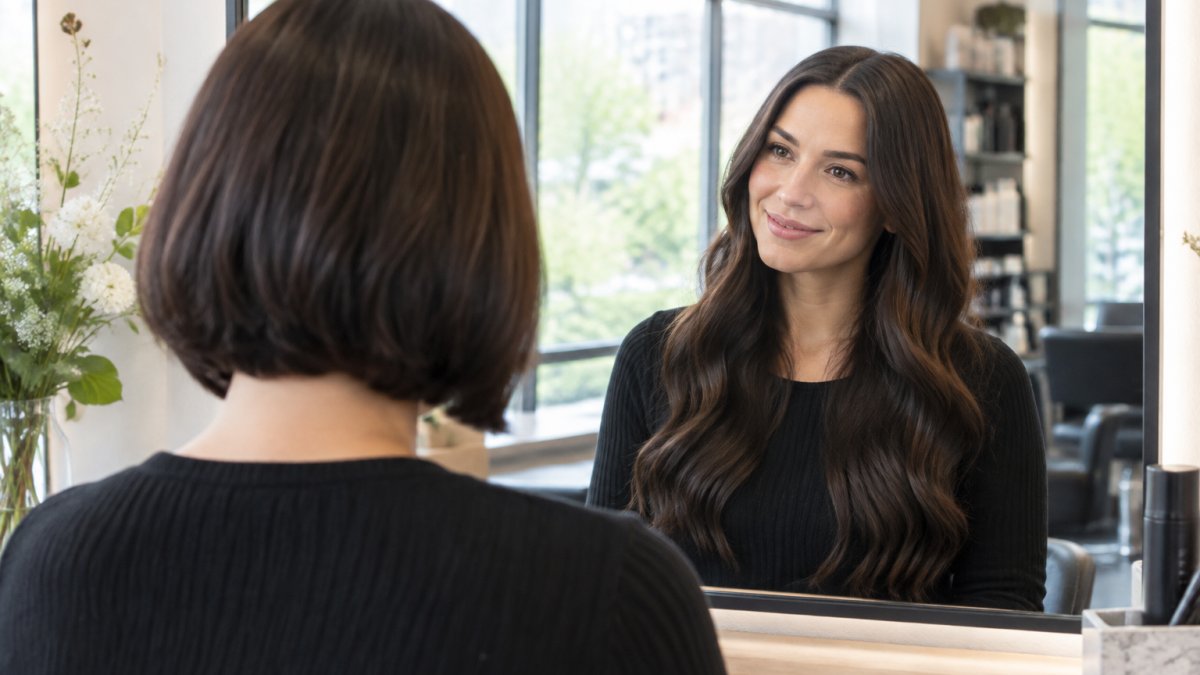
Bob to Long
A bob is the easiest starting point. There is enough length at the back to hide the bond row, so the join sits out of sight.
The transformation usually needs two things: a row placed just above the nape, and a face-framing piece cut to follow the jaw. The result reads as a long hairstyle with a soft front, not a wig sitting on top of a bob.
Pixie to Shoulder Length
Pixie cuts are harder. There is very little hair to cover a bond, so placement has to be precise and the first few weeks need patience.
The realistic goal here is shoulder length, not waist length. Building in stages protects the natural hair and looks far more believable. Anyone promising a full-length transformation from a pixie in one sitting is overselling.
Fine Hair, Fuller Finish
Fine hair is not the same as thin hair. Fine hair means each strand is small in diameter. Thin hair means there is less of it.
Extensions can work beautifully on fine hair, but bulk is the enemy. We cover the method choice in detail further down.
How to Blend Hair Extensions with Short Hair
Blending is where short to long hair extensions succeed or fail. The rule is simple: cut the extensions to meet the natural hair, never the other way round.
Here is the step-by-step approach we would use:
- Section the natural hair. Divide the hair into a lower, middle and top section. Clip the top layers out of the way so you can work on the lower rows without fighting the hair above.
- Fit the extension row slightly lower than feels natural at first. On short hair, a row placed too high will peek through the top layers. Start low and build upward only if needed.
- Release the top layer and check the join in a mirror. Look from the back, the side and above. The join should disappear under the natural hair, not sit on top of it.
- Point-cut the extension ends to soften the line. Straight-cut ends create a visible shelf where the extension meets the natural hair. Point-cutting breaks up that line so the two textures merge.
- Blend the face-framing pieces into the shortest natural layers. The front is where a short-to-long transformation is most obvious. Cut face-framing pieces to follow the jaw or cheekbone, not to hang straight down.
- Style with a light wave to disguise any straight-cut edges. A soft wave or bend hides the transition better than a sleek straight finish, which tends to expose the join.
- Recheck from every angle. Ask the client to turn, tilt their head and run their fingers through the hair. Movement is the real test of a blend.
A common mistake is cutting too much length off in the first pass. You cannot put it back. Trim in small amounts and check after each one.
For a fuller walkthrough of sectioning and point-cutting, our guide on how to blend extensions with hair covers the technique in detail.
The Best Hair Extensions for Short Hair
The best hair extensions for short hair are the ones with the lowest-profile attachment.
Clip-in extensions are the fastest option and suit occasional wear.
Halo extensions sit on a clear wire and work well for a temporary length boost. They suit fine hair but can slip on very short cuts.
Tape and weft methods sit flat against the head and hide under a bob far more easily.
Nano and keratin bonds give the most natural root and the most styling freedom.
For a closer look at which types suit shorter and finer hair, see our comparison of the best hair extensions for fine hair.
Hair Extension Length Guide: Choosing Your Ideal Finish
Choosing a length is about proportions, not numbers on a packet. The right finish sits somewhere between the shoulder blade and the waist for most clients, but on a short-to-long transformation the starting cut changes what is realistic in one appointment.
Three things decide it:
- Height and frame: a longer length can overwhelm a petite frame
- Natural density: very long sets need more hair to look full, not thin at the ends
- Lifestyle: long hair needs more styling time each morning
A practical starting point is one length step beyond the goal. Hair sits slightly shorter once it settles, and it gives your stylist room to trim.
Weight matters as much as length. A full-length set needs enough grams to avoid wispy ends, and our guide to the gram rules for full-volume hair explains how to work that out.
Realistic limits for very short or heavily layered hair
A pixie cut or a heavily layered short bob cannot usually jump to waist length in one sitting without the result looking obvious.
A staged transformation can work better on short hair. The first appointment might take a pixie to shoulder length, with a second appointment a few months later adding length once the natural hair has grown enough to conceal the join.
If the hair is heavily layered, a trim to even out the layers before fitting can make the blend easier. Layers that are too short at the crown will struggle to cover any attachment point, so a stylist may recommend growing them out slightly first.
At-home versus professional application
Temporary methods such as clip-ins and halos can be applied at home, and they suit clients who want a length boost for an event or a night out.
Permanent methods such as tape, weft and nano bonds should be fitted by a professional, particularly on short hair where placement is less forgiving.
Watch out: ordering a full-length set before checking whether the starting cut can conceal the attachment points often leads to a set that sits unused in a drawer.
Three factors decide the right finish, and very short or heavily layered hair has realistic limits in a single appointment.
| Factor or limit | What it means | Note |
|---|---|---|
| Height and frame | A longer length can overwhelm a petite frame | Proportion over packet numbers |
| Natural density | Very long sets need more hair to look full | Avoids thin ends |
| Lifestyle | Long hair needs more styling time each morning | Consider daily routine |
| Pixie or heavily layered bob | Cannot usually jump to waist length in one sitting | Rows and layers can show |
| Staged transformation | First appointment to shoulder length, second a few months later | Natural hair grows to conceal the join |
| Heavily layered hair | A trim to even out layers can make the blend easier | Crown layers may need growing out |
Hair Extensions for Fine Hair: Adding Volume Without Bulk
Fine hair responds badly to heavy methods.
The fix is fewer, flatter rows. One well-placed flat weft often beats three bulky ones.
Our FLAT WEFT - 50g is built for this. It sits closer to the scalp than any other weft method, so it adds volume without a visible bump.
For finer hair still, the NANOBOND - 50g uses the smallest bond available and stays invisible at the root. It is glue-free and heat-free, and it suits fine to medium hair.
For a full side-by-side of the options, read our comparison of the best extensions for fine hair.
Care, Wear Time and Safe Removal After a Transformation
Aftercare decides whether a transformation lasts a season or a year. The hair itself is only half the story.
Daily habits that protect the set:
- Brush from the ends upward, never tug at the root
- Keep heat tools below the bond line
- Wash with a sulphate-free shampoo and condition the mid-lengths
- Tie hair loosely at night to reduce friction
- Book a check-up appointment between fittings
Wear time depends on the method. Keratin bonds are built for four to five months between appointments. Our INVISI TAPE - 50g is reusable for up to 8 to 12 applications and costs £137.00 for 50g.
Watch out: pulling a bond out at home is the fastest way to lose natural hair with it. Always have removal done professionally.
Our guide to maintaining hair extensions for long wear sets out a full care routine.
Book Your Short to Long Consultation
The gap between a disappointing set and a seamless one is rarely the hair. It is the consultation, the method match and the blending.
A proper consultation should cover your starting length, your hair density, your daily routine and how long you want the set to last. Bring photos. Be honest about how much styling time you will actually commit to.
At QUEEN OF GOOD HAIR, every set is 100% single-donor virgin hair with a full chain of traceability and no silicone coating.
Get started with QUEEN OF GOOD HAIR and book a consultation that maps your transformation before a single strand is fitted.
Frequently Asked Questions
Can you get hair extensions if you have short hair?
Yes, provided your natural hair is long enough to conceal the bonds or tapes. Most short bobs and grown-out pixies can support short to long hair extensions, but a very close crop may need a few centimetres of growth first. A consultation lets a stylist check your hair density and cut before recommending a method, so you avoid bonds sitting visible at the root.
How do you blend extensions into short hair without it looking obvious?
Ask for a layered cutting approach rather than a blunt line. The stylist should point-cut the ends of the extensions and blend the face-framing sections into your own hair. Choosing a method with a flat, discreet attachment, such as tape or nano bonds, keeps the root area smooth.
Which extensions are best for fine hair going from short to long?
Fine hair suits lighter, flatter attachments. Nano bonds are the smallest option and stay hidden at the root, while flat wefts sit close to the scalp without creating bumps. Tape extensions also work well because they lie flat and can be reused. Whichever you choose, keep the amount proportionate: too much hair on a fine head looks bulky rather than natural.
How do you care for hair extensions after going from short to long?
Brush from the ends upwards with a looped bristle brush, wash with sulphate-free shampoo and keep heat styling below the attachment points. Sleep with hair loosely plaited or in a low wrap to reduce friction. Book a maintenance appointment between fittings, and never remove bonded extensions at home, as pulling them out can take your own hair with them.
