

Why a Mono Lace Topper Beats a Heavenly Tresses Alternative
Last Updated: November 24, 2026
Quick Summary
A mono lace topper is the most natural Heavenly Tresses alternative for fine, thinning crowns because its sheer hand-tied lace lets your scalp show through and allows any parting. Choose low to medium density and match the colour against real hair, not a screen, so the piece blends seamlessly with your own hair.
- Density is the first decision: low to medium almost always looks more natural on fine hair.
- Part slightly off-centre to give a natural fall and hide the clip edge.
- Blend in thin sections no wider than a finger, using light hold spray on your fingers.
- Avoid backcombing at the root, as it puts tension on fine hair and can accelerate thinning.
- Confirm the base size covers the thinning area with a small margin before ordering.
Table of Contents
- What a Natural Look Really Means for Fine Hair
- Why a Mono Lace Hair Topper Suits Thinning Crowns
- Choosing a Hair Topper for Fine Hair: Density, Base and Fit
- How to Blend a Hair Topper with Natural Hair
- Invisi Tape vs Flat Weft Extensions for a Seamless Finish
- Comparing Natural-Look Options Side by Side
- Choosing Your Mono Lace Topper and Booking a Consultation
- Frequently Asked Questions
What a Natural Look Really Means for Fine Hair
Most people chasing a Heavenly Tresses alternative for natural look are really chasing one thing: a hairline and crown that nobody questions. Fine hair makes that harder, because any bulk at the root shows immediately. A natural finish comes down to three things: a base that disappears against the scalp, a density that matches your own hair, and a colour blend that holds up in daylight.
Thin hair does not need more hair. It needs the right hair, placed where the thinning actually is.
Below, we break down how a mono lace topper works, how it compares with tape and weft extensions, and how to choose without guessing.
If you are still weighing up extension methods for finer hair, our guide to the best hair extensions for fine hair covers the full picture.
Why a Mono Lace Hair Topper Suits Thinning Crowns
A mono lace topper is a partial hairpiece built on a fine, sheer mesh base that sits over the crown, with individual strands hand-tied into the lace so they move and part like natural hair. The mesh follows the curve of your head rather than sitting on top of it.
That construction solves the specific problem fine-haired clients describe most often: width at the parting. Because each strand is tied by hand, you can part the topper anywhere, and the scalp shows through the mesh instead of a solid strip of fabric.
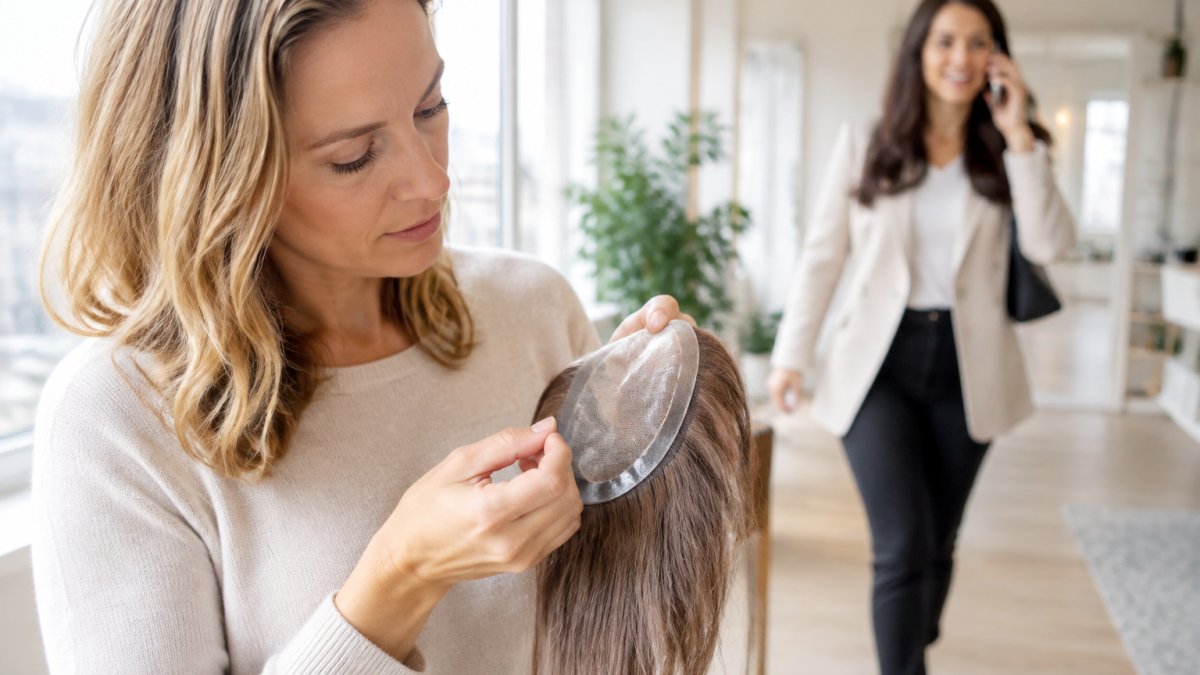
Three practical advantages for a thinning crown:
- Breathable base. The lace is light and airy, which matters if you wear it daily.
- Low-profile density. A topper adds coverage at the top without adding weight at the sides.
- Easy wear. No bonds at the root, so fine hair is not put under tension.
Choosing a Hair Topper for Fine Hair: Density, Base and Fit
Density is the first decision, not the last. For fine hair, a low to medium density almost always looks more natural than a full one, because it mirrors the weight of the hair around it. A dense topper on fine hair creates a visible step where the piece ends.
Base and fit come next. A mono lace base should sit flat against the crown with no lifting at the edges, and the cap size needs to match the area you are covering, not your full head measurement. A topper that is too large will buckle; one that is too small will leave the thinning edge exposed.
Colour is where most online orders go wrong. Screens distort tone, and a shade that looks right on a monitor can read warm or flat in daylight. Matching against real hair is the only reliable method, which is why we offer a colour ring to match your shade in real hair before you commit to an order.
How to Blend a Hair Topper with Natural Hair
Blending is what separates a topper that looks natural from one that looks obvious. The piece itself can be perfect and still fail if the transition is wrong.
Start by matching the parting. Clip the topper in place, then part your own hair along the same line so the lace disappears into your natural root. Use a tail comb to draw a clean line, but do not press hard into the scalp. With fine hair, the parting should be wide enough to accommodate the lace without exposing the clip. A common pattern is to part slightly off-centre, which gives a more natural fall and hides the clip edge.
Next, blend the front edge by taking small sections of your own hair and layering them over the topper's hairline, rather than combing the topper forward over your hair. The key is to work in thin sections, no wider than a finger, and to use a light hold spray on your fingers rather than directly on the hair. This prevents the topper hair from separating from your own. For fine hair, avoid backcombing at the root to create volume; it puts tension on the hair you have and can accelerate thinning. Instead, use a soft-bristle brush to lift the root gently.
Texture matters as much as colour. If your own hair is wavy, a straight topper will sit apart from it. A light blow-dry or a few soft waves through both your hair and the topper brings them into the same movement. Use a low heat setting and keep the dryer moving, as fine hair overheats quickly. If your hair is naturally straight, a straight topper is easier to blend, but you may need to smooth the front edge with a small amount of serum to prevent flyaways.
Density at the transition is the detail most people miss. The topper should be slightly lower density at the front edge than at the crown, so it tapers into your own hair. If the topper is uniformly dense, you will see a step where it ends. You can reduce density at the edge by gently plucking a few hairs from the front hairline with tweezers, but do this sparingly and only after the topper is clipped in place, so you can see the effect in a mirror.
This section only touches the basics. For the full step-by-step method, read our guide on how to blend extensions with hair naturally, which walks through sectioning, tension and finishing.
Watch out: over-blending at the front edge is the most common mistake. Pulling too much of your own hair forward thins the coverage you bought the topper for in the first place. A safer approach is to blend in small increments and check in natural light before adding more of your own hair over the lace.
Invisi Tape vs Flat Weft Extensions for a Seamless Finish
When clients want a seamless finish rather than a topper, the comparison usually comes down to tape and weft. Both are single-donor, cuticle-intact options in our range, and both last 12 to 24 months. The difference is where they sit and how they feel.
Invisi Tape is flat, fast and reusable for up to 8 to 12 applications. It applies in under an hour and stays undetectable even in a high ponytail. It is priced at £137.00 for 50g.
Flat Weft sits closer to the scalp than any other weft method. There is no bulk and no bump, and the volume moves like your own hair. It is also £137.00 for 50g.
| Option | Application | Reusability | Best For |
|---|---|---|---|
| Invisi Tape | Under an hour | Up to 8-12 applications | Fine hair, high ponytails |
| Flat Weft | Longer appointment | Not reusable | Maximum coverage per row |
| Mono lace topper | Clip-in, minutes | Reusable | Thinning crown only |
If a seamless, undetectable finish is your priority, browse the invisible tape range and compare it against your own hairline in a mirror before deciding.
Best for: fine hair that needs discreet root volume. Skip if: you need coverage across the whole head rather than the crown.
Comparing Natural-Look Options Side by Side
| Option | Base / Application | Hairline Realism | Density Control | Cap Fit | Texture Match | Cost (GBP) |
|---|---|---|---|---|---|---|
| Mono lace topper | Sheer mono lace, clip-in | High - hand-tied strands, any parting | Low to medium, customisable | Crown-sized, adjustable clips | Good - blends with own texture | £137.00 for 50g |
| Invisi Tape | Flat tape weft, pre-taped | Medium - low-profile root | Medium, add or remove tapes | N/A (row-based) | Good - single-donor | £137.00 for 50g |
| Flat Weft | Flat weft, sewn or micro-ring | Medium - sits close to scalp | High per row | N/A (row-based) | Good - single-donor | £137.00 for 50g |
| Keratin Bond | Keratin tip, heat-fused | High - individual strand movement | Low to medium | N/A (strand-based) | Excellent - natural fall | £127.00 for 50g |
| Nanobond | Micro-ring, no glue or heat | High - smallest bond | Low to medium | N/A (strand-based) | Excellent - natural fall | £127.00 for 50g |
Nanobond. Zero glue and zero heat, at £127.00 for 50g.
For a full side-by-side of every fine-hair method we stock, see our fine-hair extension comparison. It sets out lifespan, application time and suitability in one place.
Choosing Your Mono Lace Topper and Booking a Consultation
The right choice comes down to your thinning pattern, not a trend. If your hair is thinning at the crown and parting, a mono lace topper is the most natural answer. If you want overall volume, tape or weft will serve you better.
Before you order, confirm three things:
- The density matches your own hair, not the fullest option available
- The base size covers the thinning area with a small margin
- The colour has been matched against real hair, not a screen
Every piece in our range is 100% single-donor virgin hair with cuticle-intact strands and a full chain of traceability from donor to delivery.
Fine hair does not have to mean visible patches or bulky pieces. The challenge is matching the method to your thinning pattern, and that is exactly what a consultation solves. QUEEN OF GOOD HAIR offers single-donor virgin hair with aligned cuticles, a traceable supply chain from donor to delivery, and a 12 to 24 month lifespan across the range. Get started with QUEEN OF GOOD HAIR and find the topper or extension method that blends into your own hair.
Frequently Asked Questions
Are hair toppers a natural-looking option for fine or thinning hair?
Yes. A hair topper for fine hair works best when the base is sheer and the density is low to medium, so the piece sits flat against the crown instead of adding bulk. Matching the texture and colour to your own hair, then blending the front edge, completes the effect.
How do you choose a hairpiece that blends with your natural hair?
Start with the base size and shape so the topper covers only the thinning area, then match density to your own hair rather than going thicker. Colour should sit within a shade of your roots, and texture should mirror your natural pattern.
Which hair extension methods create the most seamless finish?
For a flat, undetectable finish, invisi tape vs flat weft extensions is the comparison most worth understanding. Tape bonds sit flat and are quick to apply, while a flat weft sits closer to the scalp than other weft methods with no bulk or bumps. Both use cuticle-intact virgin hair. Your choice depends on your hair density, how often you visit the salon and whether you prefer reusable bonds.
How should you care for human hair extensions to keep them looking natural?
Wash with a sulphate-free shampoo, condition the mid-lengths and ends, and never rub the bonds or lace base. Detangle from the ends upward with a loop brush, dry the base fully, and store toppers on a stand to hold their shape. Book tightening or removal at the interval your method needs, and avoid heavy oils near the roots.
