

Buying Ethically Sourced Hair Extensions Online
Table of Contents
- Quick Comparison: Ethically Sourced Hair Extensions
- The Benefits of Single-Donor Hair Extensions
- How to Verify Hair Extension Sourcing Before You Buy
- How Long Do High-Quality Hair Extensions Last?
- NANOBOND - 50g: The Discreet Choice for Fine Hair
- INVISI TAPE - 50g: Fast, Flat and Reusable
- KERATIN BOND - 50g: The Longest-Lasting Bond Method
- FLAT WEFT - 50g: Seamless Volume Without Bulk
- Frequently Asked Questions
Last Updated: September 16, 2026
Quick Comparison: Ethically Sourced Hair Extensions
Buying ethically sourced hair extensions online comes down to one question: can you trace the hair from a single donor to your door? At QUEEN OF GOOD HAIR, every bundle is 100% single-donor virgin hair with a full chain of traceability, and that traceability is what separates a bundle that lasts 12-24 months from one that mats within weeks.
Here is how the four methods compare before we break each one down:
| Method | Price (50g) | Best For | Bond Style | Lifespan |
|---|---|---|---|---|
| NANOBOND | £127 | Fine to medium hair | No glue, no heat | 12-24 months |
| INVISI TAPE | £137 | Fast salon appointments | Reusable tape | 12-24 months |
| KERATIN BOND | £127 | Longest wear between refits | Heat-fused strand | 12-24 months |
| FLAT WEFT | £137 | Maximum volume, no bulk | Flat weft | 12-24 months |
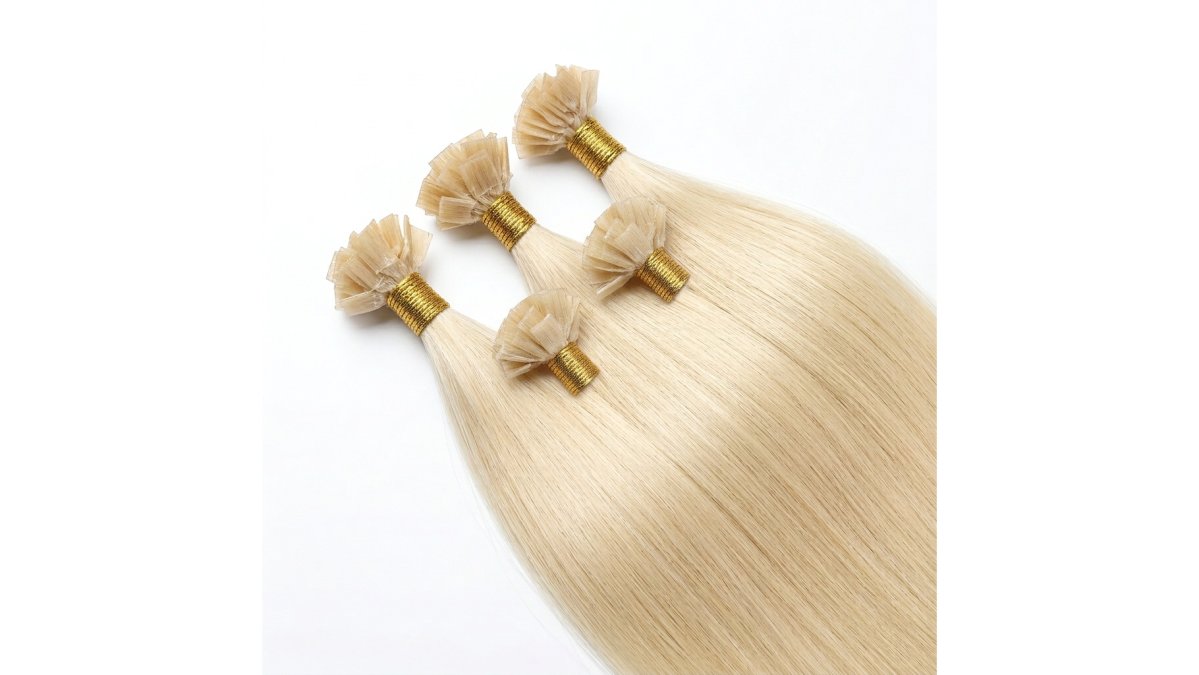
The price gap between methods is small. The gap in results is not, and it almost always traces back to sourcing.


The Benefits of Single-Donor Hair Extensions
Single-donor hair extensions are made from the hair of one person, with all cuticles aligned in the same direction. That alignment is the whole point: when every strand runs the same way, the hair behaves like your own, so it resists tangling and matting instead of gripping itself.
Mixed-donor hair is where most disappointment starts. Bundles gathered from multiple sources have cuticles running in conflicting directions, and no amount of conditioning fixes that. The hair rubs against itself, knots form at the mid-lengths, and the bundle sheds. A common mistake is blaming the wearer's aftercare for matting that was built into the bundle at the factory.
Single-donor hair also takes colour and heat styling far better, because it has not been stripped and coated to hide mixed quality. If you have bought "virgin hair" before and watched it mat within a month, cuticle alignment is the detail that was missing.
How to Verify Hair Extension Sourcing Before You Buy
Verifying hair extension sourcing means asking for evidence, not adjectives. "Ethically sourced" is a marketing phrase until a supplier can show you the chain from donor to delivery. A verifiable supplier will answer four questions without hesitation:
- Who was the donor? Single-donor hair means one person per bundle, and a traceable supplier can confirm it.
- How were they paid? Ethical sourcing means fair pay for donors, not collection through unknown middlemen.
- Has the hair been processed? Virgin hair should be cuticle-intact, with no silicone coating used to fake a soft finish.
- What happens if quality varies? Consistency across repeat orders is the real test for salon professionals.
That last point matters more than most buyers realise. Salon owners need every bundle to match the last one, because clients notice variation instantly. If a supplier cannot guarantee consistency, you are gambling with your reputation on every order.
The UK advertising regulator, the Advertising Standards Authority, requires that environmental and ethical claims be substantiated, so a supplier making "ethically sourced" claims should be able to back them up. If they cannot, treat the claim as decoration.
How Long Do High-Quality Hair Extensions Last?
High-quality hair extensions typically last 12 to 24 months with proper care, while lower-grade or coated hair often degrades within a few months. The lifespan difference comes down to cuticle integrity: hair that keeps its cuticles intact holds moisture and structure, while stripped hair loses both.
Wear method affects how often you need maintenance, not how long the hair itself survives. Bonded methods generally need refitting every 4-5 months, while tape methods can be reapplied several times before the hair itself needs replacing. Daily washing shortens any extension's life, so most specialists recommend washing two to three times a week and always using sulphate-free products.
The practical test is simple. If your extensions are still soft, tangle-free and colour-stable at the six-month mark, the hair was genuinely good quality. If they are dry and knotting by month two, the problem was the bundle, not your routine.
NANOBOND - 50g: The Discreet Choice for Fine Hair
Fine hair is where most extension methods fail, because bulky bonds show through. NANOBOND solves this with the smallest bond on the market, completely invisible at the root, and it is the method I would recommend first for anyone with fine to medium hair who worries about extensions looking obvious.
There is no glue and no heat in the application, which means no damage to the natural hair during fitting. The 50g bundle is 100% single-donor virgin hair with intact cuticles, priced at £127, and it carries the same 12-24 month lifespan as the rest of the range.
INVISI TAPE - 50g: Fast, Flat and Reusable
Tape extensions have a reputation for being the budget option. That reputation is outdated when the hair itself is single-donor virgin quality. INVISI TAPE applies in under an hour, sits flat against the head, and stays undetectable even in a high ponytail.

The reusability is the standout feature: each set can be reapplied up to 8-12 times, which changes the cost-per-wear calculation entirely. At £137 for 50g of cuticle-intact, single-donor hair, the tape method often works out cheaper over a year than replacing lower-grade bundles every few months.
KERATIN BOND - 50g: The Longest-Lasting Bond Method
Keratin bond extensions are individual strands fused to natural hair with a gentle heat wand, and they remain the longest-lasting bond method available. For clients who want to sit in the chair as rarely as possible, this is the gold standard, with refits typically needed every 4-5 months.
The strand-by-strand application means the most natural movement of any method, because each bond is placed to follow the natural fall of the hair. At £127 for 50g, it is also the most accessibly priced method in the range, which surprises people who assume the longest-lasting option costs the most.
The trade-off is appointment time. Keratin bonding is meticulous work, so expect a longer fitting than tape. What you get in return is a long gap between maintenance visits and styling freedom that matches natural hair.
FLAT WEFT - 50g: Seamless Volume Without Bulk
Flat wefts sit closer to the scalp than any other weft method, which is why they are the go-to choice for clients who want serious volume without visible bumps. If you have ever felt a traditional weft ridge through your hair, the flat weft is the answer.
At £137 for 50g of single-donor virgin hair, the flat weft delivers density that moves exactly like natural hair, with no bulk and no matting at the attachment points. The cuticle-intact construction means the hair can be coloured and heat-styled alongside your own.
Where it is not the right pick: clients with very fine hair may find nano bonds more discreet, since even a flat weft adds some weight at the root.
Choosing ethically sourced extensions online is really a test of transparency. If a supplier cannot tell you who the donor was, how they were paid, and whether the hair has been coated, the "ethical" label means nothing.
Frequently Asked Questions
How can I tell if hair extensions are ethically sourced?
Look for transparency about the full supply chain. A provider should explain where the hair comes from, how donors are paid, and whether the hair is single-donor. Ask for details on cuticle alignment and whether the hair has been coated in silicone. If a brand cannot answer these questions, treat the ethical claim with caution. Traceability from donor to delivery is the clearest sign of genuine ethical sourcing.
What does 'single-donor' mean in hair extensions?
Single-donor means all the hair in a bundle comes from one person, rather than being collected from multiple sources and mixed together. This matters because the cuticles all run in the same direction, which reduces tangling and matting. When buying ethically sourced hair extensions online, single-donor hair is a strong indicator of quality and ethical practice, as it is easier to trace back to the source.
Are there regulations for the human hair trade in the UK?
The human hair trade in the UK is not governed by a single dedicated regulator. General consumer protection law applies, including the Consumer Rights Act 2015, which requires goods to be as described. This means ethical claims must be accurate. If a seller states hair is single-donor or ethically sourced and it is not, that could be a breach of consumer law. Always buy from sellers who provide clear, verifiable information.
How do I spot fake ethical claims on hair extension websites?
Fake ethical claims are often vague. Look for specifics: named sourcing partners, details about donor payment, and evidence of cuticle alignment. Check whether the website explains what 'virgin hair' means in their context and whether they mention silicone coating. A trustworthy seller will welcome questions about sourcing. If the language is generic and no proof is offered, be sceptical. Verified reviews from independent buyers also help.
What is the difference between virgin hair and processed hair?
Virgin hair has not been chemically treated, coloured, or permed. It retains its natural cuticle layer, which is why it tangles less and lasts longer. Processed hair has been chemically altered to change its colour or texture, which strips the cuticle and leads to faster matting. When buying ethically sourced hair extensions online, virgin hair is generally the better investment for longevity and natural blending.