

Best Luxury Hair Extensions for Salons: 2026 Guide
Table of Contents
- Why Luxury Hair Extensions for Salons Are Judged on Cost Per Wear
- Quick Comparison: Four Professional Hair Extensions Systems
- NANOBOND: The Discreet Choice for Fine and Medium Hair
- INVISI TAPE: Fast Fitting and the Most Reusable Method
- KERATIN BOND: The Longest-Wear Strand-by-Strand Method
- FLAT WEFT: Low-Profile Volume That Moves Like Natural Hair
- What Separates Virgin Hair Extensions From Coated Alternatives
- Why Single-Donor Hair Extensions Keep Salon Results Consistent
- Frequently Asked Questions
Last Updated: 5 October 2026
Why Luxury Hair Extensions for Salons Are Judged on Cost Per Wear
The best luxury hair extensions for salons are not the cheapest per bundle. They are the ones that survive the most washes, the most heat styling, and the most client appointments before they need replacing. That is the number that decides whether a client rebooks or quietly goes elsewhere.
At QUEEN OF GOOD HAIR, we have built our entire range around that single calculation. Every bundle we sell is 100% single-donor virgin hair with intact cuticles, ethically sourced with fair pay for donors, and rated for a 12 to 24 month lifespan. No silicone coating, no mixed-donor blending.
Luxury hair extensions is a term the industry throws around loosely. In practice, it means hair that has never been chemically stripped, never coated to fake shine, and never mixed across donors. That is the difference between hair that still looks good at month eight and hair that mats by week six.
Below, we break down the four professional systems we supply, what each one costs per wear, and which client each method actually suits.
Quick Comparison: Four Professional Hair Extensions Systems
Each system below uses the same single-donor virgin hair. The difference is the bond method, the fitting time, and how the hair behaves on different hair types.
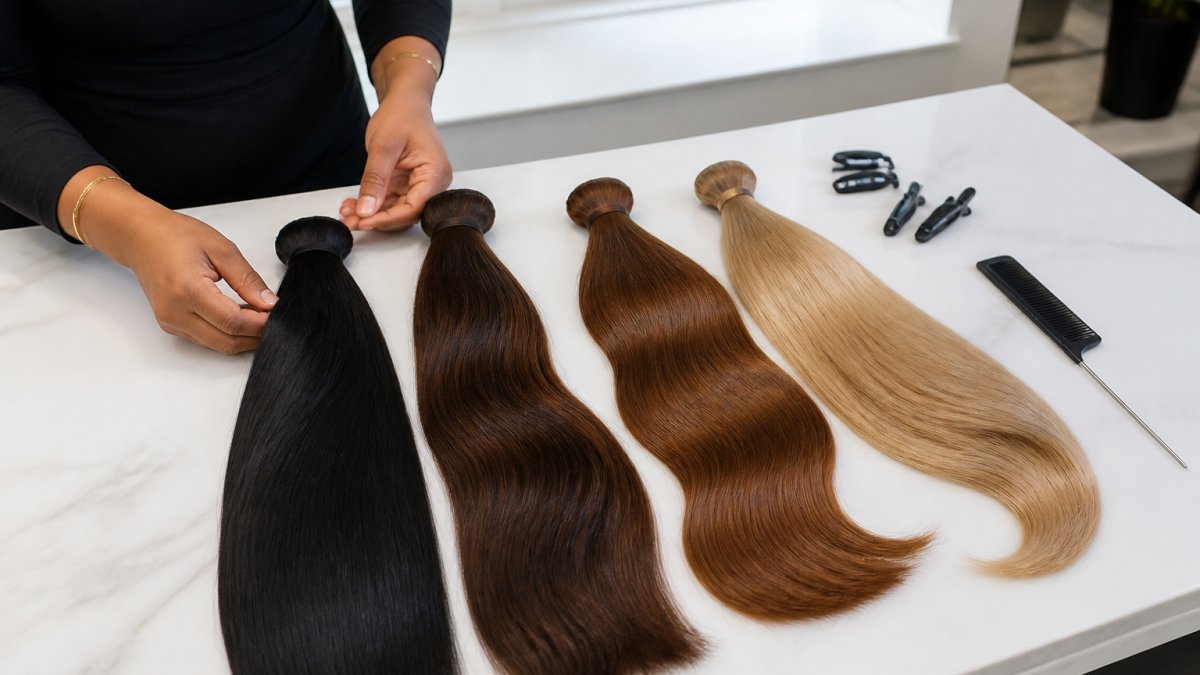
| System | Price (50g) | Fitting Time | Reusability | Best For |
|---|---|---|---|---|
| NANOBOND | £127.00 | Moderate | 12-24 months | Fine to medium hair |
| INVISI TAPE | £137.00 | Under an hour | 8-12 applications | Speed and high ponytails |
| KERATIN BOND | £127.00 | Longer | 4-5 months between appointments | Longest wear per strand |
| FLAT WEFT | £137.00 | Fast | 12-24 months | Low-profile volume |
For a salon carrying one line, INVISI TAPE and FLAT WEFT cover most client requests. For finer hair, NANOBOND is the safer fit.

NANOBOND: The Discreet Choice for Fine and Medium Hair
NANOBOND is the smallest bond on the market and the one we recommend first for clients with fine or medium hair. There is no glue and no heat involved in the bond itself, which means no damage at the root and no visible attachment point.
The NANOBOND - 50g is £127.00 for 50g of 100% single donor virgin hair, cuticle-intact, rated for a 12 to 24 month lifespan. It is the system we point salons toward when a client has previously been told extensions "won't work" on their hair type.
The honest limitation: nano bonds take longer to fit than tape, so if your chair time is tight, this is not the fast option.
INVISI TAPE: Fast Fitting and the Most Reusable Method
INVISI TAPE is the fastest system we supply and the most reusable. A full set can be applied in under an hour, and each weft can be reused for up to 8 to 12 applications before it needs replacing.

The INVISI TAPE - 50g is £137.00 for 50g of single donor virgin hair, cuticle-intact, with the same 12 to 24 month lifespan as the rest of the range. The tapes are flat enough to be undetectable even in a high ponytail, which matters for clients who wear their hair up regularly.
Where it falls short: tape bonds need more careful aftercare around the attachment point, and clients who use heavy oil-based products near the root will shorten the life of the tapes.
KERATIN BOND: The Longest-Wear Strand-by-Strand Method
KERATIN BOND is the gold standard for strand-by-strand work. Individual strands are fused with a gentle heat wand, giving a seamless, natural finish and the longest-lasting bond method available. Clients can typically go 4 to 5 months between appointments.

The KERATIN BOND - 50g is £127.00 for 50g of 100% single donor virgin hair, cuticle-intact, and rated for 12 to 24 months of wear. Because the bonds are individual, the hair moves completely naturally and can be styled exactly like the client's own.
The trade-off is fitting time. Keratin bonding is the slowest method in this list, so it suits salons that can charge accordingly and clients who want the longest gap between refits.
FLAT WEFT: Low-Profile Volume That Moves Like Natural Hair
FLAT WEFT sits closer to the scalp than any other weft method we stock. There is no bulk and no bump at the attachment point, just seamless volume that moves exactly like natural hair.
The FLAT WEFT - 50g is £137.00 for 50g of single donor virgin hair, cuticle-intact, with a 12 to 24 month lifespan. For clients who want maximum volume without visible rows, this is our pick.
The one drawback: flat wefts are less suited to very fine hair at the crown, where even a low-profile weft can show. For those clients, NANOBOND remains the better route.
What Separates Virgin Hair Extensions From Coated Alternatives
Virgin hair extensions are hair that has never been chemically treated, coloured, or coated. The cuticle stays intact and aligned in one direction, which is why the hair resists tangling and matting instead of drying out and knotting after a few washes.
Coated hair is different. A silicone layer is applied to mimic shine and slip, and it feels convincing on day one. That coating washes away over the first few weeks, and what is left underneath is often lower-grade hair that was never going to last.
This is the single biggest reason clients say "I've tried virgin hair before and it matted within a month." In most cases, they were sold coated hair under a virgin label. The UK trading standards guidance on misleading product descriptions is clear that describing hair as virgin when it has been coated is a misdescription.
Why Single-Donor Hair Extensions Keep Salon Results Consistent
Single-donor hair extensions come from one donor, which means the cuticle direction, texture, and colour are consistent across the entire bundle. Mixed-donor hair is assembled from multiple sources, and the cuticles run in different directions. That is what causes tangling at the root and uneven colour under salon lighting.
For salons, consistency is the whole game. A client who books a colour match expects the same result every time. Single-donor sourcing is the only way to guarantee that bundle five matches bundle one.
This is also where traceability matters. Our full chain of traceability runs from donor to delivery, and donors are paid fairly. If a client asks where their hair came from, you can answer.
If you want a line you can stand behind at the chair, start with our Shop All range. Every system is single-donor, cuticle-intact, and rated for 12 to 24 months. Get started with QUEEN OF GOOD HAIR and give your clients hair that still looks like theirs at month twelve.
Frequently Asked Questions
What should salons look for when choosing luxury hair extensions?
Look at four things: cuticle direction, donor traceability, the bond or weft system, and realistic lifespan. Cuticle-intact hair keeps its alignment through washing, which is what stops matting. Traceability tells you whether the supply is ethical and repeatable. The method decides fitting time and how often clients rebook. Lifespan decides your true cost per wear, and a system lasting 12-24 months usually works out cheaper per client than a cheaper bundle replaced every few months.
What is the difference between Remy and virgin hair extensions?
Remy means the cuticles all run in the same direction, but the hair may still be collected from multiple donors and can be chemically processed. Virgin hair extensions are unprocessed and uncoloured, and when they are also single-donor, every strand in the bundle comes from one head. That combination keeps the cuticles aligned naturally rather than relying on processing to smooth them, which is why virgin hair extensions resist tangling for longer and take colour more predictably.
How long do high-quality human hair extensions last?
The hair itself can last 12-24 months with proper care, but the wear cycle depends on the method. Keratin bond clients typically rebook every 4-5 months, while tape systems can be reused for up to 8-12 applications before the hair is retired. Daily heat styling, harsh sulphate shampoos and brushing wet bonds all shorten that window. Advise clients on aftercare at the fitting and the hair will usually outlast the bond.
Are single-donor hair extensions better for salons?
For consistency, yes. With single-donor hair extensions, every bundle in an order behaves the same way: the same texture, the same density, the same response to colour and heat. Multi-donor bundles can vary between orders, and clients notice when a new set feels different from the last. If you run several stylists or fit multiple clients from one order, single-donor supply is the simplest way to guarantee the result matches what you quoted.
How should clients care for professional hair extensions?
Give clients a written routine at the fitting. Use a sulphate-free shampoo, condition mid-lengths to ends only, and never condition the bonds or tape. Brush from the ends upwards with a loop or soft bristle brush, and always dry bonds fully before styling. Advise a silk pillowcase and a loose braid at night, and book a maintenance check at the four-week mark. Most premature shedding traces back to wet brushing or heat applied directly to the bond.