

7 Ways 50g Hair Extension Packs Transform Layered Styles
Last Updated: November 4, 2026
Quick Summary
50g hair extensions are the ideal weight for layered styles because they add movement and softness without collapsing the layers under bulk. Use one pack for volume, or 100g to 150g for volume plus soft length, and map the grams into the sides and crown rather than the perimeter.
- A 50g pack is roughly a quarter head by professional measure.
- Building real length takes five to six packs, or 250g to 300g.
- Flat weft suits long fluid layers; tape suits side volume and fine hair.
- Never concentrate more than about a third of your total grammage in one zone.
- Offset each row by two to three centimetres to avoid a visible shelf line.
Table of Contents
- Why 50g Hair Extension Packs Suit Layered Cuts
- How Many Grams of Hair Extensions for Volume
- Flat Weft vs Tape Extensions for Layering
- Blending Hair Extensions with Natural Layers
- Weight Distribution Mapping for 50g Packs
- Texture Matching and Cutting Techniques for Seamless Layers
- Choosing Your 50g Pack: A Buying Guide
- Frequently Asked Questions
Why 50g Hair Extension Packs Suit Layered Cuts
Layered cuts demand movement, and movement demands the lightness that 50g hair extensions provide.
That shift matters for anyone working with layers.
Here is the core tension most guides ignore. A layered cut is defined by what you remove, not what you add.
Below we break down how many grams you actually need, how flat weft and tape compare for layering, and how to map weight so the finish looks grown, not installed.
How Many Grams of Hair Extensions for Volume
For volume alone, one 50g pack is typically the recommended starting point, and that figure comes straight from trade guidance rather than guesswork.
That gap explains most disappointing installs. Clients ask for "a bit more hair" and get length quantities applied to a volume problem.
A simple gram rule for layering:
- Volume only: 50g to 100g, placed at the sides and crown
- Volume plus soft length: 100g to 150g, distributed through the mid-lengths
- Full length with layers: 200g and up, which usually means a different method entirely
For the fuller breakdown of how grammage translates into density, our guide to 7 gram rules for full-volume hair extensions walks through the thresholds section by section.
Flat Weft vs Tape Extensions for Layering
Flat weft wins for long, fluid layers; tape wins for speed and targeted side volume.
A flat weft is a machine-sewn strip of hair, attached in a horizontal track, designed to lie flush against the scalp. The 2026 trend data backs this: Great Lengths' 2026 trend report identifies weightless lengths and thinner, more flexible weft systems as the direction the industry is moving, precisely because layered cuts need a track that disappears under movement.
Tape extensions are pre-taped sandwiches of hair applied in small sections. They are faster to fit and easier to place precisely, making them strong for filling thinner side areas.
| Feature | Flat Weft (50g) | Invisi Tape (50g) |
|---|---|---|
| Profile against scalp | Flattest available | Low-profile tabs |
| Best for | Long layers, movement | Side volume, fine hair |
| Fitting time | Longer | Under an hour |
| Reusability | Limited refits | Up to 8-12 applications |
| Price per 50g pack | £137.00 | £137.00 |
Both our FLAT WEFT - 50g and INVISI TAPE - 50g packs are cuticle-intact single-donor hair with a 12 to 24 month lifespan, so the choice is about placement, not quality.


Blending Hair Extensions with Natural Layers
Blending is where a good install becomes invisible, and it starts before the scissors come out. Texture match first, colour second, cut third.
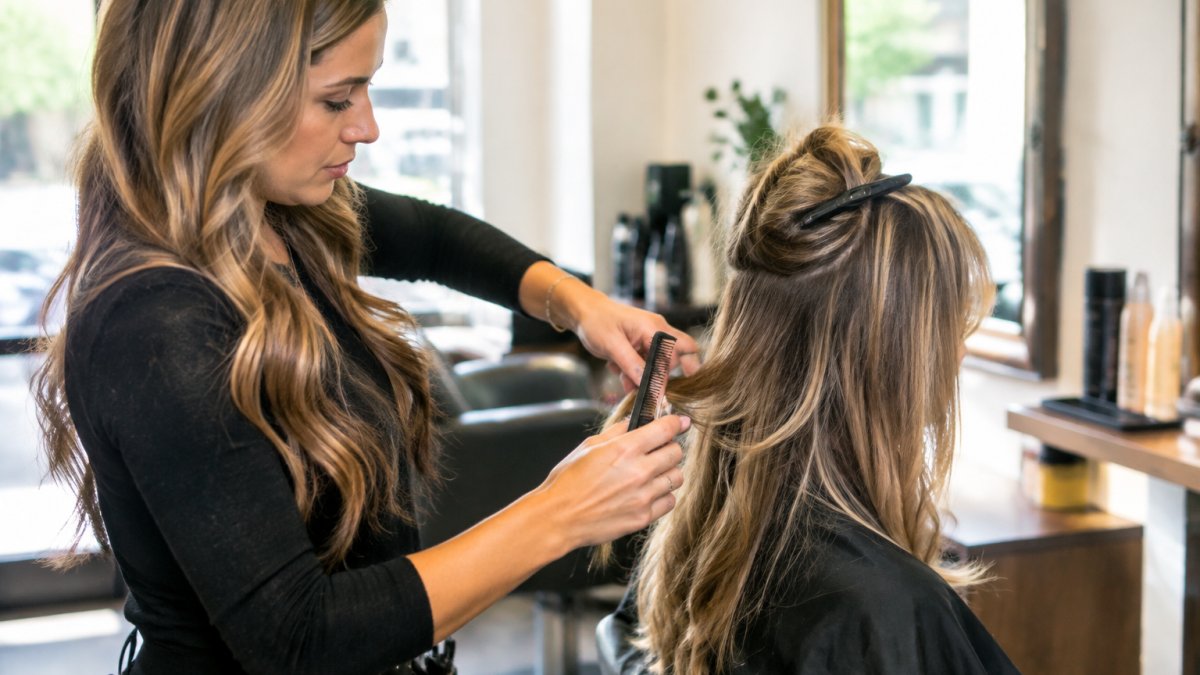
A common mistake is blending by cutting blunt across the extension ends, which creates a shelf.
For the step-by-step version, our guide to blending extensions with natural hair covers sectioning patterns and the dry-check method in detail.
Weight Distribution Mapping for 50g Packs
Most extension failures are distribution failures, not product failures.
Map before you fit. Divide the head into four zones and assign weight by what each zone needs to do:
- Nape: structural support, minimal weight, keep it light
- Sides: the volume zone, where 50g packs earn their keep
- Crown: lift and root coverage, small sections only
- Perimeter: blending only, no weight
Weight belongs where the natural hair is densest, because that is where it hides. Placing grams into a thin perimeter is how installs end up visible at the hairline.
A second rule: never concentrate more than roughly a third of your total grammage in one zone. Spread it, and the layers keep their swing.
A working gram map for a single 50g pack
For a first 50g pack on a layered cut, a practical split that most practitioners find reliable is:
- Sides: 20g to 25g, split evenly left and right, fitted at the mid-length rather than the root
- Crown: 10g to 15g, in two or three small sections for lift
- Nape: 5g to 10g, only if the cut needs support at the back
- Perimeter: 0g, always
That leaves a small reserve. Keep it. A 5g offcut is the difference between a blend that sits and one that needs a second pack.
How the map changes with the cut
A blunt, one-length cut with soft face-framing layers carries weight lower and further forward. Put more of the 50g into the sides at cheek and jaw level, and keep the crown light so the top does not dome.
A heavily layered shag or wolf cut needs weight through the mid-lengths and almost nothing at the root, because the cut already creates lift.
A long, face-framed layer with a strong perimeter wants the 50g concentrated in two side panels following the natural fall line, with the nape left alone. The perimeter is where the eye goes first, so any weight there shows.
Mapping around a shelf line
A shelf appears when extension ends stop at the same horizontal level as a natural layer. The fix is vertical stagger: offset each weft or tape row by two to three centimetres from the row above, and never let two rows terminate on the same line.
Watch out: fitting a 50g pack as a single continuous row across the back of the head is the most common cause of a visible horizontal line, because the row end and the natural layer end coincide.
Checking the map before you commit
Section the hair dry and clip the 50g pack into place without bonding or taping. Look at the head from the side, the back and above. If any zone reads heavier than the natural hair around it, move grams before you fix anything.
For readers working out total grammage before mapping, our guide to 7 gram rules for full-volume hair extensions sets out the thresholds this map is built on.
Texture Matching and Cutting Techniques for Seamless Layers
Texture mismatch is the quiet killer of layered installs. A coarse extension against fine natural hair will separate no matter how well it is coloured. Most guides skim this because texture is harder to describe than colour, so they default to shade charts. The technique below decides whether a 50g pack disappears into a layered cut.
Match on three axes before fitting:
- Diameter: fine hair needs fine hair, not just "straight" hair
- Wave pattern: match the natural bend, not the styled finish
- Cuticle alignment: aligned cuticles mean the extension behaves like the natural hair when it moves
Testing the match before you buy or fit
Take a small section of the 50g pack, wet it, and let it dry naturally alongside a section of the client's own hair. Do not stretch, blow-dry or straighten either.
A second test is the pinch test. Roll a few strands of the extension and a few of the natural hair between thumb and forefinger. If the extension feels noticeably thicker per strand, it is a diameter mismatch even if it looks identical on the weft.
What to do when the match is close but not exact
A 50g pack that is slightly too straight for the natural wave can often be brought into line by a light water wave set before fitting, rather than returned. A pack that is too coarse for fine natural hair cannot be fixed by styling, and should be swapped for a finer grade.
Cutting the transition zone
On cutting, the technique that separates a professional finish from a visible one is slide-cutting the transition zone. Rather than cutting the extension to a fixed length, slide the blade down through the last few centimetres where extension meets natural hair, softening the join so the eye reads one continuous layer.
Work in sections no wider than two fingers. Take the extension and the natural hair together, hold them at a slight tension, and slide the blade from mid-length down to the ends in one controlled pass. Two light passes beat one heavy pass, because a heavy pass removes too much and leaves a step.
Sectioning for a layered cut
Section the head into horizontal bands that follow the natural layers, not the extension rows. Each band gets its own blend check before you move up.
Watch out: cutting extensions with blunt hairdressing scissors on a wet section will blunt the ends and cause the very frizzing you are trying to avoid. Cut dry where you can, and keep one pair of scissors reserved for extension work.
The dry-check method
Blend dry, always. Wet hair lies about how a layer will fall, and a blend that looks seamless on a wet section can show a step the moment it dries. After each band, dry the section naturally or with a cool setting, then look at it from the side.
For the step-by-step version, our guide to blending extensions with natural hair covers sectioning patterns and the dry-check method in detail.
Choosing Your 50g Pack: A Buying Guide
Buy on provenance, not on the label. "Remy" and "virgin" are used loosely across the trade, and a Silent Spring Institute study reported in 2026 found that over 90% of hair extensions tested contained harmful chemicals, which tells you how little the average product label guarantees.
A practical checklist before you commit:
- Is the hair single-donor, or blended from multiple sources?
- Are the cuticles aligned in one direction?
- Is there a silicone coating that will wash out and reveal the real texture?
- Can the supplier trace the hair from donor to delivery?
- What is the stated lifespan, and is it backed by anything?
Our 50g packs are 100% single-donor virgin hair with a full chain of traceability and no silicone coating, priced at £127.00 for keratin bond and nano bond, and £137.00 for Invisi Tape and Flat Weft. The listed lifespan is 12 to 24 months.
For readers weighing up a first 50g purchase in more depth, our professional guide to buying 50g hair extensions covers the questions to ask a supplier before ordering.
Frequently Asked Questions
Is 50g of hair extensions enough for a full head?
A 50g pack equals roughly a quarter head of hair, so it is not enough for a full-head application on its own. For adding volume to fine hair, one pack of 50g hair extensions is typically recommended. For a full head with length, you would need several packs. Layered styles often use 50g packs as side thickeners or to build subtle volume at the crown rather than covering the whole head.
How do you layer hair extensions to look natural?
Section the hair horizontally and place extensions so the shortest layer sits at the crown and longer lengths fall below. Cut into the ends at a downward angle to mirror your natural layers, then point-cut the tips for a softer finish. Matching the extension texture to your own hair and mapping weight distribution before application keeps the blend invisible. A 50g pack is ideal for adding one discreet layer without bulk.
Can you mix different weights of hair extensions for a layered effect?
Yes. Mixing weights is a common way to build dimension. Use lighter 50g packs higher up for subtle volume and heavier packs lower down for length. This graduated approach stops the crown looking heavy and lets the layers fall naturally. Map the weight across the head first so no single section carries too much hair.
What is the difference between flat weft and tape extensions for layering?
Flat wefts sit closer to the scalp than traditional wefts, giving a low-profile base that suits layered cuts without bumps. Tape extensions apply in under an hour and lie flat, making them undetectable even in high ponytails. For fine hair and soft layers, flat wefts distribute weight evenly; tape suits clients who want a fast, reusable option. Both come in 50g packs, so you can build layers gradually.
Layered styles reward restraint, and the hardest part is resisting the urge to add more hair than the cut can carry. If you want 50g packs built for exactly that discipline, QUEEN OF GOOD HAIR supplies single-donor, cuticle-intact hair with full traceability, a 12 to 24 month lifespan and no silicone coating, in flat weft, tape, nano and keratin bond formats. Get started with QUEEN OF GOOD HAIR and build layers that move like they grew there.
