

Signs of High Quality Human Hair: 7 Checks to Know
Table of Contents
- Why Most Buyers Can't Spot High Quality Human Hair
- How to Tell If Hair Extensions Are Real Human Hair
- Virgin Hair vs Human Hair: What the Labels Actually Mean
- How to Check Hair Extensions for Tangling and Shedding
- Why Single Donor Hair Extensions Resist Matting
- The High Quality Human Hair Checklist Before You Buy
- Conclusion
- Frequently Asked Questions
Last Updated: October 6, 2026
Why Most Buyers Can't Spot High Quality Human Hair
Most buyers cannot spot high quality human hair because they judge it by shine and softness, and both can be faked. Silicone coating gives cheap hair a glossy, silky feel that washes out after a few weeks. At QUEEN OF GOOD HAIR, we see this constantly: bundles that feel wonderful in the packet and mat within a month.
The real signs of high quality human hair are structural, not cosmetic. They show up in how the cuticles sit, how the hair behaves when wet, and how it sheds over time.
This guide breaks down seven checks you can run before you buy. Below, we show you exactly how to test a bundle in minutes, and which red flags mean you should walk away.
How to Tell If Hair Extensions Are Real Human Hair
The quickest way to tell if hair extensions are real human hair is the fibre test. Real hair burns to ash and smells like burnt hair. Synthetic fibre melts into a hard bead and smells like plastic.
Here is how to run it safely:
- Snip a single strand from an inconspicuous area
- Hold it with metal tweezers over a heatproof surface
- Bring it near a flame, do not drop it in
- Watch the reaction and note the smell
Real hair also feels cool and slightly rough when you rub it against the cuticle direction. Synthetic fibre feels uniformly smooth both ways.
The Burn Test and Why It Is Not Enough
The burn test confirms fibre type. It tells you nothing about cuticle quality.
Hair can be real and still be poor quality. Mixed-donor hair, acid-bathed hair and stripped hair all pass the burn test. They fail everywhere else.
So treat the burn test as a starting point. The checks below matter far more.
Virgin Hair vs Human Hair: What the Labels Actually Mean
Virgin hair is human hair that has never been chemically processed, dyed or bleached. Human hair is any hair from a human head, and it may be chemically treated, mixed from several donors, or coated in silicone.
That gap is where most confusion lives. Every virgin bundle is human hair. Very few human hair bundles are virgin.
Cuticle intact means the outer layer of each strand still runs in one direction. This is what stops tangling.
Watch for these label traps:
- "Human hair" alone tells you nothing about processing
- "Virgin" without a donor count is a marketing word
- "Remy" means cuticles align, but not that hair is unprocessed
- "Double drawn" describes thickness, not quality
Ask one direct question: is this single donor, and is the cuticle intact? A supplier who cannot answer plainly is telling you something.
How to Check Hair Extensions for Tangling and Shedding
To check hair extensions for tangling and shedding, comb a wet section from mid-length to ends and count what comes away. A few strands is normal. A clump means the cuticles are stripped or misaligned.
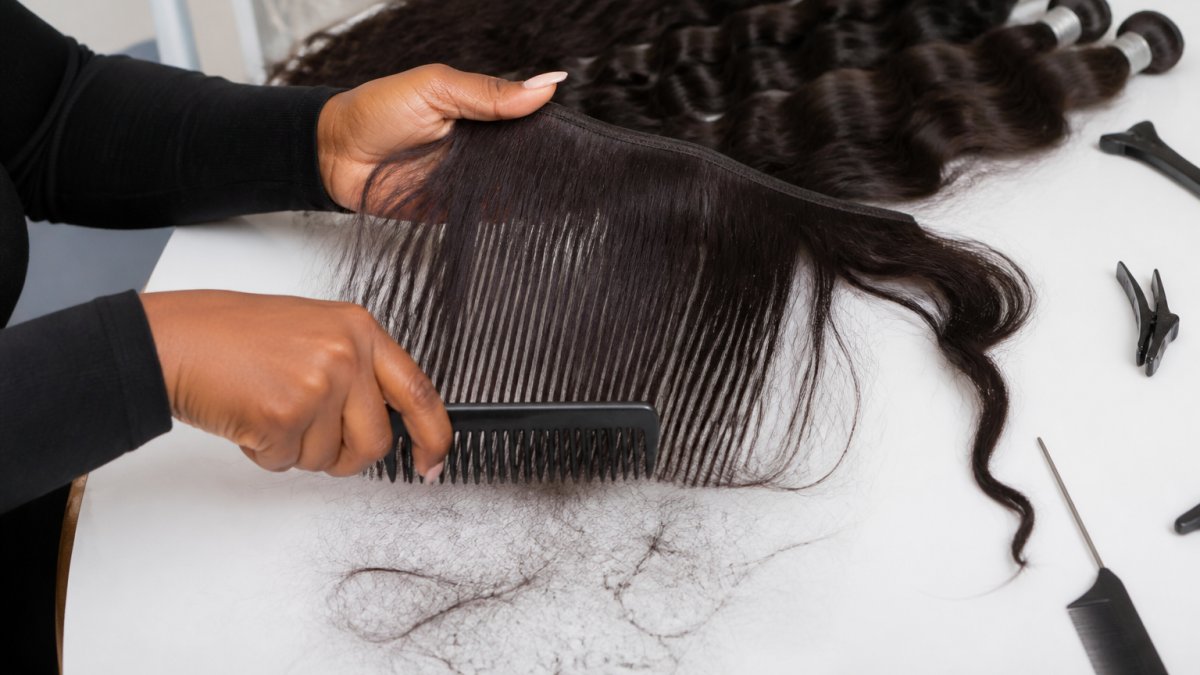
Run these tests before you commit:
- Wet comb test: mist the hair, comb through, check the comb teeth
- Shed test: run your fingers down the weft and count loose hairs
- Scrunch test: scrunch wet hair and let it dry, then check for matting at the root
- Curl test: wrap a section around your finger and release, good hair springs back
Then check the weft itself. A loosely stitched weft sheds from day one. Look for tight, even stitching and a sealed edge.
Why Single Donor Hair Extensions Resist Matting
Single donor hair extensions resist matting because every strand comes from one head, so the cuticles all run the same way. When cuticles align, strands glide past each other instead of catching and locking.
Mixed-donor hair does the opposite. Bundles collected from several heads have cuticles running in different directions. Those strands grip each other. That grip is what you feel as matting.
Direction matters more than most people realise. Even single-donor hair can mat if the bundle is assembled with strands turned the wrong way.
This is why traceability is worth paying for. Our full chain of traceability runs from donor to delivery, so we can confirm the hair came from one source and was handled in one direction. That is also why we use no silicone coating: there is nothing to strip away and nothing hiding underneath.
The High Quality Human Hair Checklist Before You Buy
Run this checklist before you pay. It takes ten minutes and saves months of frustration.
| Check | What Good Looks Like | Red Flag |
|---|---|---|
| Fibre test | Burns to ash, smells like hair | Melts to a hard bead |
| Cuticle direction | Smooth one way, rough the other | Smooth both directions |
| Wet comb test | Few loose strands | Clumps on the comb |
| Shed test | Minimal shedding at the weft | Handfuls of loose hair |
| Weft stitching | Tight, even, sealed edge | Loose threads, gaps |
| Donor count | Single donor, stated clearly | "Mixed" or no answer |
| Coating | No silicone, natural feel | Slick, chemical smell |
A bundle that passes all seven checks will last. Ours carry a 12 to 24 month lifespan, and that comes down to cuticle integrity rather than marketing.
For fine or thin hair, bond choice matters as much as hair quality. Our NANOBOND - 50g uses the smallest bond on the market at £127.00, which keeps the root invisible on finer hair. Salons wanting a faster application tend to choose our INVISI TAPE - 50g at £137.00, applied in under an hour.


Conclusion
Spotting high quality human hair comes down to structure, not shine. Check the cuticle, count the donors, and test the weft before you buy.
That is the standard we build QUEEN OF GOOD HAIR around: 100% single-donor virgin hair, full traceability from donor to delivery, and ethically sourced with fair pay for donors. Verified buyers like Jodie, Libby Bryson and Robina have shared their results, and our founder Tammy Laroche brings 30 years of hair experience to every sourcing decision.
Get started with QUEEN OF GOOD HAIR and choose extensions that hold their condition for 12 to 24 months, not weeks.
Frequently Asked Questions
How can you tell if human hair is high quality?
Check three things: cuticle integrity, donor alignment, and how the hair behaves after washing. High quality human hair has cuticles that all run the same direction, which stops strands catching on each other. Run your fingers from root to tip on a wet strand: it should feel smooth, not rough or grippy. Ask whether the hair is single donor and cuticle-intact, and check whether any silicone coating is used, since coatings mask damage that appears once they wash out.
Does high-quality human hair tangle or shed?
Some shedding is normal in the first few days as loose strands from the bundle work free. After that, a well-made weft should lose very little hair. Tangling usually points to cuticles facing different directions, which happens when hair from multiple donors is mixed together. Single donor, cuticle-aligned hair keeps its cuticles running the same way, so strands glide past each other instead of locking. If a set mats within weeks, the cuticle alignment is the likely cause.
How long do high-quality human hair extensions last?
Premium single donor virgin hair typically lasts 12 to 24 months with proper care, while lower-grade hair may need replacing within a few months. Bond method matters too: our Keratin Bonds are ideal for 4-5 months between appointments, and our Invisi Tape can be reused for up to 8-12 applications. Daily washing, heat styling and harsh products shorten any lifespan, so use sulphate-free shampoo and always fit extensions with a qualified stylist.
What is the difference between virgin hair and human hair?
Human hair is any hair sourced from a person, including hair that has been chemically treated, coloured or processed. Virgin hair is unprocessed human hair that has not been bleached, dyed or chemically altered. That means all virgin hair is human hair, but not all human hair is virgin. Virgin hair keeps its natural cuticle layer intact, which is why it tangles less and holds colour better than processed alternatives.