

How to Spot Fake Virgin Hair: 7 Checks Before You Buy
Table of Contents
- Why Fake Virgin Hair Is So Common in the UK
- The Virgin Hair vs Synthetic Hair Test: Three Checks Anyone Can Do
- How to Tell If Hair Is Processed: The Cuticle and Coating Checks
- The Benefits of Single Donor Hair (and Why Fakes Can't Copy Them)
- Red Flags to Watch For Before You Pay
- How to Verify a Supplier's Claims: Traceability, Testing and Aftercare
- Frequently Asked Questions
Last Updated: September 23, 2026
Why Fake Virgin Hair Is So Common in the UK
Fake virgin hair is real human hair that has been chemically treated, coated, or mixed with synthetic strands, then sold as unprocessed "virgin" hair. It is common because virgin hair costs more to source, and mislabelling is hard to police at the point of sale.
The problem starts with the word itself. "Virgin" should mean hair that has never been coloured, relaxed, permed, or coated. Many sellers use it loosely, or not at all honestly.
We understand the frustration when a bundle looks perfect for three weeks, then tangles, sheds, and mats. That pattern almost always points to mixed cuticles or a silicone coating.
So before you spend money, you need tests you can run yourself. This guide covers seven checks, from a simple burn test to the questions that expose a weak supply chain.
The Virgin Hair vs Synthetic Hair Test: Three Checks Anyone Can Do
The virgin hair vs synthetic hair test is a set of three simple checks, the burn test, the water test, and the heat test, that reveal whether strands are real human hair or plastic fibre. Each takes under five minutes and needs no special tools.
Here is how to run all three:
- Burn test: Singe one strand and smell the smoke.
- Water test: Drop a few strands into a glass of water.
- Heat test: Touch a hot styling tool to a small section.
Run them on a spare strand, never on your installed set. If a seller refuses to give you a loose strand to test, that alone tells you something.
The Burn Test: What Real Human Hair Smells and Does
Real human hair smells like burnt hair when you burn it. It forms a soft ash that crumbles between your fingers.
Synthetic fibre does the opposite. It melts into a hard plastic bead and smells like burning plastic. That smell is unmistakable once you know it.
Here is the full comparison:
| Result | Real Human Hair | Synthetic Fibre |
|---|---|---|
| Smell | Burnt hair | Burning plastic |
| Residue | Soft, crumbly ash | Hard plastic bead |
| Flame behaviour | Burns, does not melt | Melts and balls up |
If your strand melts, stop. You are not holding virgin hair.
The Water and Heat Test
Real, uncoated hair absorbs water slowly and sinks over time. Heavily coated hair floats or beads water on the surface because silicone repels it.
For the heat test, press a hot styling tool against a spare strand. Real hair can take heat and will straighten or curl as normal. Synthetic fibre will melt, stick, or fuse together.
A common mistake is testing on hair that has already been washed with heavy conditioner. Product residue skews both tests. Use a clean, dry strand.
How to Tell If Hair Is Processed: The Cuticle and Coating Checks
To tell if hair is processed, look at the cuticle and check for a coating. Virgin hair keeps its cuticle layer intact and aligned in one direction. Processed hair has had that layer stripped or chemically altered.
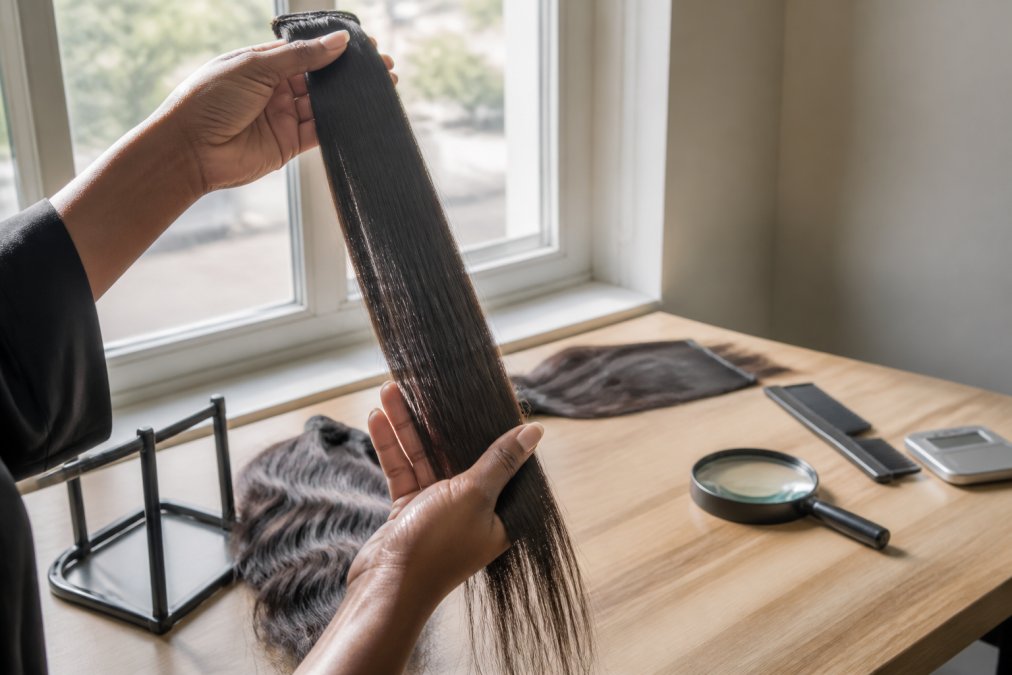
Run your fingers from root to tip, then tip to root. Real virgin hair feels smooth one way and slightly rougher the other. That roughness is the cuticle. If both directions feel identical and slick, a coating is likely hiding the truth.
Coating checks:
- Silicone shine: A plastic-like gloss that fades after two or three washes.
- Stiffness at the root: Coating builds up near the weft and feels tacky.
- Squeaky feel: Over-processed hair feels thin and stripped when wet.
If the shine disappears after a few washes and the hair turns dry and dull, you were sold coated hair. That is one of the clearest signs.
The Benefits of Single Donor Hair (and Why Fakes Can't Copy Them)
The benefits of single donor hair come down to one thing: every strand has its cuticle facing the same direction. When cuticles align, strands glide past each other instead of catching and locking.
Mixed-donor hair cannot copy this. When bundles from different donors are combined, some cuticles face up and some face down. They grip each other. That is why mixed hair tangles and mats within weeks.
Single donor hair also keeps its natural moisture and takes colour more predictably. You can lift it, tone it, and style it with heat without the fibre breaking down.
This is the core difference between hair that lasts a few months and hair that lasts a year or more. Our NANOBOND extensions use 100% single donor virgin hair with the cuticle fully intact, which is why they hold up to daily wear.

Red Flags to Watch For Before You Pay
The clearest red flag is a price that is too low for genuine virgin hair. Real single donor hair costs more to source, so a bargain bundle usually means mixed or coated hair.
Watch for these warning signs:
- No loose strand available: A confident seller will always give you one.
- Vague sourcing: "Ethically sourced" with no detail about the donor.
- Too-good pricing: Deep discounts on "100% virgin" hair.
- No aftercare guidance: Real suppliers explain washing, heat limits, and bond care.
- Pressure to buy fast: Urgency is used to stop you testing.
Another red flag is a seller who cannot tell you the hair's origin or how it was collected. Traceability matters. If they dodge the question, assume the worst.
How to Verify a Supplier's Claims: Traceability, Testing and Aftercare
You verify a supplier by asking for traceability, offering to test a strand, and checking their aftercare support. A supplier with nothing to hide will welcome all three.
Ask these questions directly:
- Can you confirm this is single donor hair?
- Is the cuticle intact and aligned?
- Can I test a loose strand before buying?
- What aftercare do you recommend?
- How long should this hair last with daily wear?
Look for a full chain of traceability, from donor to delivery. At QUEEN OF GOOD HAIR, every bundle is single donor, ethically sourced, and traceable, with no silicone coating. Our INVISI TAPE and KERATIN BOND ranges both carry a 12 to 24 month lifespan, so you can judge quality by how long the hair actually lasts.


For consumer protection on misleading claims, the Competition and Markets Authority guidance on unfair trading sets out what sellers can and cannot claim. If a supplier's promises do not match the hair you receive, you have grounds to act.
Frequently Asked Questions
What is the difference between virgin hair and synthetic hair?
Virgin hair is unprocessed human hair that has never been chemically treated, coloured or bleached, so it keeps its natural cuticle and can be heat-styled and coloured. Synthetic hair is made from plastic fibres, which melt under heat, cannot be dyed, and usually last only a few weeks. The virgin hair vs synthetic hair test is simple: burn a single strand. Real human hair smells like burnt hair and turns to ash; synthetic hair smells like burning plastic and forms a hard bead.
How can you tell if hair extensions are 100% human hair?
Start with the burn test on a spare strand, then check the cuticles. Run your fingers from root to tip, then tip to root. Real virgin hair feels smooth one way and slightly rougher the other because all cuticles face the same direction. If it feels identical both ways, the cuticles have likely been stripped or the hair is coated in silicone to fake softness. Also check for a natural taper and slight variation in strand thickness, which processed bundles often lack.
Does real virgin hair tangle easily?
No. Genuine virgin hair with intact, aligned cuticles resists tangling because every strand flows in the same direction. Tangling and matting within the first few weeks is usually a sign of mixed cuticles, chemical processing or a silicone coating wearing off. Single donor hair from one person has the most consistent cuticle alignment, which is why it tangles far less than bundles assembled from multiple sources.
How do I know if my hair extensions have been chemically processed?
Look for a uniform colour from root to tip with no natural variation, an overly glossy finish that feels slick rather than soft, and a slight chemical smell when damp. Processed hair often loses its wave pattern after one wash or dries out quickly. A simple check is to wet a small section: virgin hair returns to its natural texture, while processed hair can go limp, frizzy or straight. If in doubt, ask the supplier for proof of origin and donor details before buying.
Spotting fake virgin hair comes down to testing, not trusting. Run the burn, water, and heat checks, inspect the cuticle, and ask for traceability before you pay. If you want hair you do not have to second-guess, QUEEN OF GOOD HAIR offers 100% single donor virgin hair with aligned cuticles, a full chain of traceability, and a 12 to 24 month lifespan. Shop the range and start with hair that lasts.