

Flat Weft vs Genius Weft for Fine Hair: Which Is Better?
Table of Contents
- Flat Weft vs Genius Weft for Fine Hair: The Core Differences
- Flat Weft vs Genius Weft: Comparison Table
- Pros and Cons of Each Weft for Fine Hair
- Why Genius Weft Extensions for Fine Hair Suit Delicate Strands
- Choosing the Best Hair Extensions for Fine Hair
- How to Install Weft Extensions on Fine Hair
- Weft Extension Maintenance for Fine Hair
- Conclusion
- Frequently Asked Questions
Last Updated: 17 October 2026
Flat Weft vs Genius Weft for Fine Hair: The Core Differences
Flat weft vs genius weft for fine hair comes down to one question: which method adds volume without adding visible bulk? Both are thin, both are machine-sewn, and both sit closer to the scalp than traditional clip-in strips. The difference lies in the return, the folded edge at the top of the weft.

At QUEEN OF GOOD HAIR, we supply both methods in 100% single-donor virgin hair, so we see how each behaves on delicate strands over months of wear. A flat weft is a machine-sewn strip with a thin, folded return that lies flat against the scalp. A genius weft is a finer version of the same idea: the return is cut away almost entirely, leaving a lighter, thinner strip with no folded bulk at the top.
That single design change matters more on fine hair than on any other hair type. Fine strands have less density to disguise a lumpy attachment point, so every millimetre of bulk shows through. Below, we break down how each weft sits against the scalp, where each one wins, and how to choose between them.
How Each Weft Sits Against the Scalp
A flat weft rests against the scalp with its folded return creating a slim but noticeable ridge. The strip is flexible and moulds to the curve of the head, and the fold protects the stitching. On fine hair, that ridge can be disguised with correct sectioning, but it needs a skilled hand at the install.
Genius weft extensions for fine hair sit flatter still. Because the return is removed, the weft has almost no ridge at all. The trade-off is that the stitching sits closer to the edge, so the strip must be handled gently during fitting and removal. In practice, the genius weft disappears under fine hair in a way the flat weft cannot quite match.
Flat Weft vs Genius Weft: Comparison Table
| Feature | Flat Weft | Genius Weft |
|---|---|---|
| Return edge | Thin folded return | Return cut away |
| Bulk against scalp | Slim but visible ridge | Almost no ridge |
| Best suited to | Fine to medium hair | Fine and very fine hair |
| Installation speed | Faster, more forgiving | Slower, needs precision |
| Stitching position | Protected inside fold | Exposed at the edge |
| Durability in wear | Very good | Good with careful handling |
| Styling versatility | Cut, colour, heat-style | Cut, colour, heat-style |
| Lifespan with care | 12-24 months | 12-24 months |
Both options in this table come from our single-donor range, cuticle-intact and free from silicone coating, so the comparison is about construction rather than hair quality.
Pros and Cons of Each Weft for Fine Hair
Flat Weft: Pros and Cons
The flat weft is the more forgiving of the two, and that forgiving nature is exactly why many fine-haired clients start here.
Pros:
- The folded return protects the stitching, so the weft tolerates handling and removal well
- Sits flat enough for most fine hair types when installed by a trained stylist
- Faster to fit, which keeps salon appointments shorter
- Holds colour and heat styling without the edge fraying
Cons:
- The folded edge creates a slight ridge that very fine hair can reveal
- Less invisible than a genius weft at the crown and parting
- Needs careful blending to avoid a detectable line
Genius Weft: Pros and Cons
The genius weft trades a little toughness for invisibility, and for very fine hair that trade usually pays off.
Pros:
- The thinnest profile of any weft method, with no folded return to show through
- Blends into fine hair with minimal sectioning
- Ideal for clients who wear hair up or parted
- Lighter weight, so less tension on delicate roots
Cons:
- The exposed stitching demands gentle handling during fitting and removal
- Slower to install, which adds salon time
- Less forgiving of rough brushing at the attachment point
Why Genius Weft Extensions for Fine Hair Suit Delicate Strands
Weight is the argument. Fine hair carries less volume per strand, so every gram of extension pulls harder on the root than it would on thick hair. The genius weft's cut-away return removes the heaviest part of the strip, and that reduced weight means less tension across the scalp.
There is a visual argument too. Fine hair is translucent at the ends and lies close to the head. A bulky attachment point interrupts that smooth line immediately. The genius weft's near-flat profile keeps the silhouette continuous, which is why it reads as natural even in bright light.
Our FLAT WEFT - 50g is built on the same single-donor, cuticle-intact principle, priced at £137.00, and the 50g weight suits fine hair that needs volume without heaviness. Cuticle-aligned hair resists tangling at the root, which matters most where fine strands meet the weft.
Choosing the Best Hair Extensions for Fine Hair
The best hair extensions for fine hair are the thinnest ones the wearer can maintain properly. Start with the hair itself: single-donor, cuticle-intact virgin hair lasts longer and tangles less than mixed-donor hair, because the cuticles all face the same direction. Then match the method to the wearer.
- Very fine, fragile hair: genius weft, fitted slowly, with gentle aftercare
- Fine to medium hair: flat weft, which offers more durability for a similar profile
- First-time wearers: flat weft, because the protected stitching forgives beginner mistakes
- Clients who wear hair up often: genius weft, for the invisible parting
Ask three questions before booking: how fine is the hair at the crown, how often will the client heat-style, and can they commit to gentle brushing? The answers decide the method faster than any product label.
How to Install Weft Extensions on Fine Hair
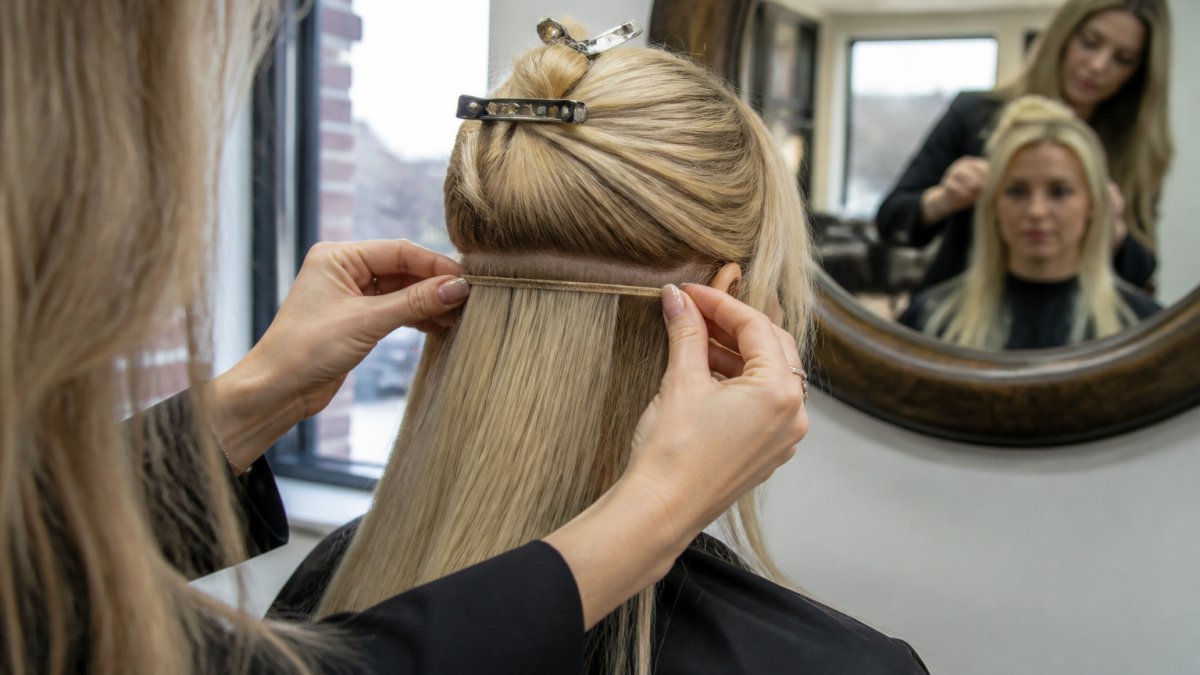
Installing weft extensions on fine hair rewards patience over speed. The goal is a flat, tension-free row that follows the natural curve of the head.
- Section the hair cleanly, leaving enough natural hair at the crown to cover the top row
- Create a straight, horizontal parting at the nape, no wider than the weft strip
- Position the weft close to the scalp and check the profile in a mirror before securing
- Secure the row with the method your training supports, keeping tension even across the width
- Blend the natural hair over the row and check for ridges under direct light
- Repeat row by row, leaving a gap between rows on very fine hair
Weft Extension Maintenance for Fine Hair
Weft extension maintenance for fine hair is mostly about protecting the attachment point. Brush from the ends upward, holding the root section with one hand so the weft takes no tugging. Wash with sulphate-free products, condition the mid-lengths and ends only, and dry the weft line thoroughly.
- Detangle daily with a loop brush, working upward in small sections
- Wash no more than twice a week and support the weft while rinsing
- Avoid oil-based products near the stitching
- Book a professional check every six to eight weeks
- Store wefts loosely on a hanger between wears
Fine hair shows product build-up faster than thick hair. Keep styling products light and rinse thoroughly, and the weft will keep its flat profile for its full lifespan.
Conclusion
Choosing between these two wefts is really a choice about how much invisibility your client's hair demands. Very fine hair usually wins with the genius weft, while fine to medium hair gets more durability from the flat weft.
Fine hair leaves no room for bulky extensions, and that is exactly the problem our single-donor virgin hair solves. Every bundle is cuticle-intact, traceable from donor to delivery, and built to last 12 to 24 months without silicone coating to fake the shine. Explore the FLAT WEFT - 50g at £137.00 and see how a flat profile transforms fine hair. Shop All with QUEEN OF GOOD HAIR and give delicate strands the seamless volume they deserve.
Frequently Asked Questions
Are flat weft or genius weft extensions better for fine hair?
Neither wins outright, and the flat weft vs genius weft decision comes down to the result you want. A flat weft sits closest to the scalp and lies flattest, so it hides well under fine hair. A genius weft is made without a folded return, so it has almost no bulk at the seam and blends softly. For very fine or thinning hair, the genius weft usually gives the most invisible finish. For a flatter, denser placement, the flat weft is the stronger choice.
Can weft extensions damage fine hair?
Damage usually comes from weight and tension rather than the weft itself. Fine hair supports less weight per row, so keep rows thin, space them correctly and avoid over-tightening the attachment. Book regular refits so the hair is never pulled from regrowth, and use a gentle sulphate-free wash routine. Installed and maintained properly, wefts can be worn on fine hair without lasting harm.
How many weft rows are suitable for fine hair?
Most fine-haired clients suit two to three rows, placed at the nape, mid-back and, where needed, the sides. Each row should carry a light weight so the natural hair is not overloaded. A single row of a denser weft often looks more natural on very fine hair than several heavy rows. Your stylist should assess density and head shape before deciding.
How often do weft extensions need maintenance?
Plan a refit every six to eight weeks, when natural regrowth starts to loosen the attachment. Between appointments, brush gently twice daily, wash with a sulphate-free shampoo and keep heat styling away from the seam. With careful weft extension maintenance, single-donor, cuticle-intact hair can last 12 to 24 months before replacement.