

Best Long Lasting Hair Extensions 2026: Top Picks
Table of Contents
- Quick Comparison: Long Lasting Hair Extensions in 2026
- How We Evaluated These Long Lasting Hair Extensions
- 1. NANOBOND - 50g: Best for Fine to Medium Hair
- 2. KERATIN BOND - 50g: The Longest-Lasting Bond Method
- 3. INVISI TAPE - 50g: Best for Fast Application and Reusability
- 4. FLAT WEFT - 50g: Best for Seamless Volume on Thicker Hair
- How to Maintain Hair Extensions for Longevity
- Which Long Lasting Hair Extensions Should You Choose?
- Frequently Asked Questions
Last Updated: September 23, 2026
Quick Comparison: Long Lasting Hair Extensions in 2026
If you're shopping for the best long lasting hair extensions 2026 has to offer, the difference between a set that survives a year and one that mats within weeks comes down to one thing: cuticle integrity. Here at QUEEN OF GOOD HAIR, we've built our entire range around 100% single-donor, cuticle-intact virgin hair, which is why every method below carries a 12 to 24 month lifespan.
Quick Picks:
- Best for fine to medium hair: NANOBOND - 50g, £127
- Longest-lasting bond method: KERATIN BOND - 50g, £127
- Best for fast application and reusability: INVISI TAPE - 50g, £137
- Best for seamless volume on thicker hair: FLAT WEFT - 50g, £137
Below, we'll break down how each method performs in practice, what it costs, and which one suits your hair type.

| Method | Price (50g) | Best For | Lifespan |
|---|---|---|---|
| NANOBOND | £127 | Fine to medium hair | 12-24 months |
| KERATIN BOND | £127 | Longest wear between refits | 12-24 months |
| INVISI TAPE | £137 | Speed and reusability | 12-24 months |
| FLAT WEFT | £137 | Thicker hair, seamless volume | 12-24 months |
How We Evaluated These Long Lasting Hair Extensions
We judged every method on four criteria: bond longevity, how well it blends with natural hair, application and removal time, and cost per wear. Lifespan figures come from our own product specifications rather than general industry claims.
The single biggest factor in longevity is whether the hair's cuticle stays aligned and intact. Once cuticles are stripped or mixed across donors, the hair tangles, mats, and sheds prematurely, no matter how careful you are with aftercare. That's why we only assess cuticle-intact, single-donor hair here.
We also weighed practical trade-offs. A method that lasts beautifully but takes four hours to fit isn't right for everyone, and a fast method that shows at the root fails a client with fine hair. Each pick below reflects those trade-offs honestly.
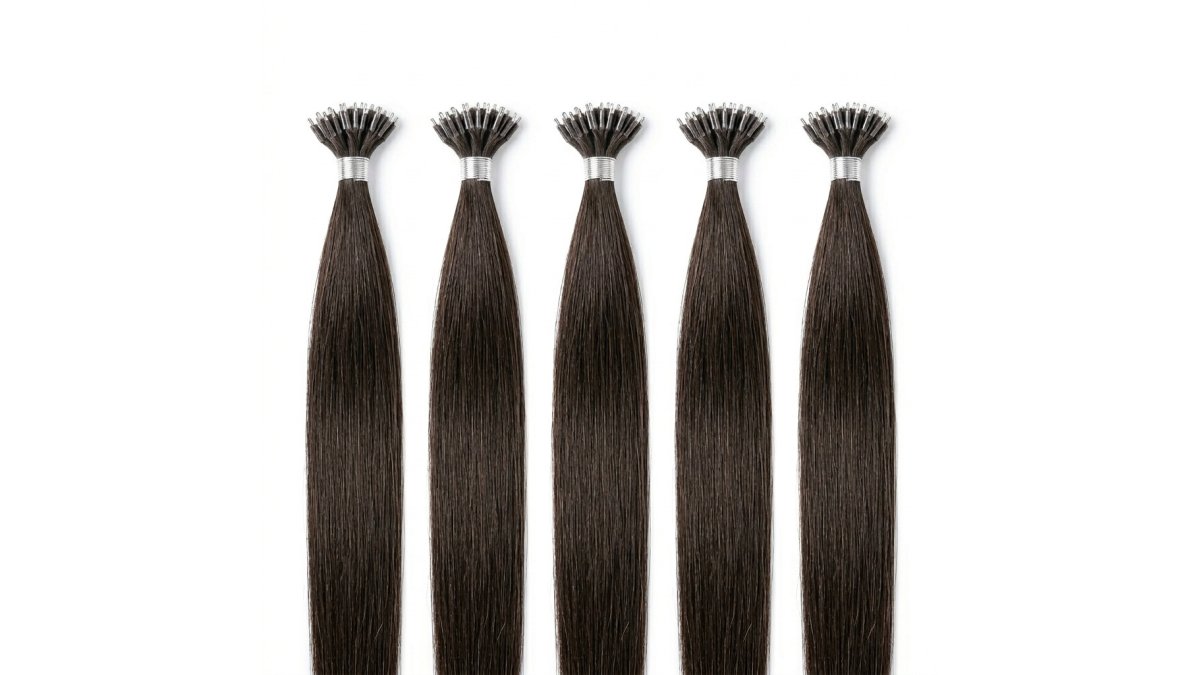
1. NANOBOND - 50g: Best for Fine to Medium Hair
NANOBOND uses the smallest bond on the market, applied with zero glue and zero heat. For fine or thin natural hair, that matters enormously: bulky bonds show through, and heat or adhesive can stress fragile strands.
The nano ring sits completely invisible at the root, so even clients worried about extensions looking obvious get a natural result. Because there's no glue or heat involved, there's no damage to your own hair during application or removal.
Pros:
- Discreet enough for fine and medium hair types
- No glue, no heat, no damage to natural hair
- 100% single donor, cuticle-intact virgin hair
- 12-24 month lifespan
Cons:
- Requires a professional fitting and regular maintenance appointments
- Not the fastest method to apply
At £127 for 50g, it's the same price as our keratin bond and the most versatile option for anyone with finer hair.

2. KERATIN BOND - 50g: The Longest-Lasting Bond Method
Keratin bond is the gold standard for wear time. Individual strands are fused with a gentle heat wand, creating a seamless, natural finish that holds for four to five months between appointments.
If your priority is going longer between refits, this is the method to choose. The trade-off is that it uses heat during application, so it suits clients with healthy natural hair rather than very fragile strands.
Pros:
- Longest wear between appointments, typically 4-5 months
- Seamless, natural-looking finish
- Single-donor virgin hair with intact cuticles
- 12-24 month lifespan
Cons:
- Heat application isn't ideal for very fragile hair
- Removal should always be done professionally
At £127 for 50g, keratin bond offers the strongest cost-per-wear of the four methods if you're happy with fewer, longer appointments.
3. INVISI TAPE - 50g: Best for Fast Application and Reusability
Invisi tape is the fastest route to a full head of extensions. Application takes under an hour, and the flat, low-profile strips stay undetectable even in a high ponytail.

The standout feature is reusability. Each set can be refitted for up to 8-12 applications, which brings the effective cost per wear down considerably over the lifespan of the hair. That makes it a strong choice for salon professionals managing repeat clients.
Pros:
- Applied in under an hour
- Reusable for 8-12 applications
- Undetectable, even in high ponytails
- 12-24 month lifespan
Cons:
- Tape bonds need more frequent refitting than keratin
- Not always the best match for very oily scalps
At £137 for 50g, the higher upfront price is offset by how many times the hair can be reused.
4. FLAT WEFT - 50g: Best for Seamless Volume on Thicker Hair
Flat weft sits closer to the scalp than any other weft method, which means no bulk and no bumps. For clients with thicker natural hair who want volume rather than length alone, it delivers a finish that moves exactly like their own hair.
Where fine-haired clients need the discretion of nano bonds, thicker hair can carry a weft comfortably. The result is seamless volume with none of the ridge lines that cheaper weft methods are known for.
Pros:
- Sits closer to the scalp than other weft methods
- No bulk or visible bumps
- Ideal for adding volume to thicker hair
- 12-24 month lifespan
Cons:
- Less suited to very fine hair
- Requires a professional fitting to sit correctly
At £137 for 50g, flat weft is the pick for clients chasing natural movement and density.
How to Maintain Hair Extensions for Longevity
Maintenance is where most extension sets fail early. Even premium single-donor hair will matt and shed if you brush it wrong, wash it with harsh products, or sleep on it unprotected.
Follow these habits to protect your investment:
- Brush from the ends upward with a loop or wide-tooth comb, never tugging from the root
- Wash with sulphate-free shampoo and always use a conditioner on the mid-lengths and ends
- Dry gently, never rubbing the bonds or tape with a rough towel
- Sleep with hair loosely plaited or in a low ponytail on a silk pillowcase
- Book refit appointments before bonds loosen rather than after
- Avoid heat styling directly on the bond points
Used well, this routine is what carries a set through its full 12-24 month lifespan. The hair itself is only half the equation.
Which Long Lasting Hair Extensions Should You Choose?
Match the method to your hair type first, then your lifestyle. Fine or thin hair points straight to NANOBOND, the most discreet option at £127. If you want the longest possible gap between appointments, KERATIN BOND is the answer. For speed and reusability, INVISI TAPE wins. And for seamless volume on thicker hair, FLAT WEFT is the clear pick.
Every method above shares the same foundation: 100% single-donor virgin hair, full traceability from donor to delivery, and no silicone coating to fake a shine that washes out. That's the difference between hair that lasts a season and hair that lasts a year or more.
Choosing extensions that genuinely last means looking past marketing claims and asking harder questions about sourcing, cuticle integrity, and aftercare.
Frequently Asked Questions
Which type of hair extensions last the longest?
Keratin bond extensions typically last the longest between refits, with 4 to 5 months of wear before maintenance is needed. Nano bond, tape and flat weft methods generally need refitting every 6 to 8 weeks. However, the hair itself can last 12 to 24 months across all methods when it is single-donor, cuticle-intact virgin hair. Bond type affects refit frequency, while hair quality determines overall lifespan.
How can I make my hair extensions last longer?
Wash extensions no more than twice a week with sulphate-free shampoo, always use a heat protectant before styling, and brush gently from the ends upward with a loop or wide-tooth comb. Avoid sleeping on wet hair and tie it loosely in a plait at night. Book refits as soon as bonds start to slip. These habits help maintain hair extensions for longevity, protecting both the hair and the bonds.
Are virgin hair extensions better for longevity?
Yes. Virgin hair that is single-donor and cuticle-intact resists tangling and matting far better than processed or coated hair. Silicone-coated extensions may feel soft initially but degrade quickly once the coating washes off. Cuticle-aligned virgin hair keeps its structure through washing and styling, which is why it can last 12 to 24 months compared with a few months for lower-grade alternatives.
What are the best hair extensions for fine hair that won't cause damage?
Nano bond extensions are the best hair extensions for fine hair because the bond is the smallest available and sits invisibly at the root without adding bulk. They use no glue and no heat, which reduces stress on delicate strands. Tape and weft methods can work on fine hair too, but nano bonds distribute weight more evenly and are less likely to show through thin sections.
Do professional-grade extensions justify the higher price point?
They do when you calculate cost per month of wear. A 50g set of single-donor virgin hair at £127 to £137 lasting 12 to 24 months costs far less per month than cheaper hair replaced every 8 to 12 weeks. Professional-grade extensions also hold colour and texture better, so salon clients get consistent results and fewer corrective appointments.